
Rodamientos de rodillos cruzados are essential components in robotics, precision rotary tables, Equipo medico, and semiconductor manufacturing systems. Their defining feature—cylindrical rollers arranged in a 90-degree alternating pattern within V-shaped raceways—allows a single bearing to simultaneously handle radial, axial, y cargas de momento. Para ingenieros, accurately calculating load capacity is critical: underestimating it leads to premature failure, while overestimating it results in oversized, costly designs. This article explains the methods behind crossed roller bearing load capacity calculation, the factors that influence load ratings, and how to apply these results in real-world selection.
Understanding Load Characteristics in Crossed Roller Bearings
¿Qué diferencia a los rodamientos de rodillos cruzados?
En un rodamiento de rodillos cruzados., cylindrical rollers are mounted in V-shaped raceways and arranged so that adjacent rollers are perpendicular to each other. This 90-degree cross pattern means each roller effectively supports load in only one direction, but the combined arrangement enables multi-directional load support. En comparación con los rodamientos de bolas, the line contact between rollers and raceways distributes load over a larger area, delivering significantly higher stiffness and load capacity within the same envelope.
Radial, Axial, and Moment Loads
Crossed roller bearings are typically subjected to three types of loads, often acting simultaneously:
- Cargas radiales: Forces perpendicular to the bearing axis. These are carried by rollers oriented perpendicular to the load direction.
- Cargas axiales: Forces parallel to the bearing axis. These are carried by rollers oriented parallel to the load direction.
- Moment loads: Tilting forces that create a non-uniform load distribution across the rollers, with one side of the bearing carrying more load than the other.
Because the rollers are crossed at 90 grados, approximately half of the rollers contribute to radial load support and the other half to axial load support at any given time. This division is fundamental to crossed roller bearing load capacity calculation.
Calculating Basic Load Ratings
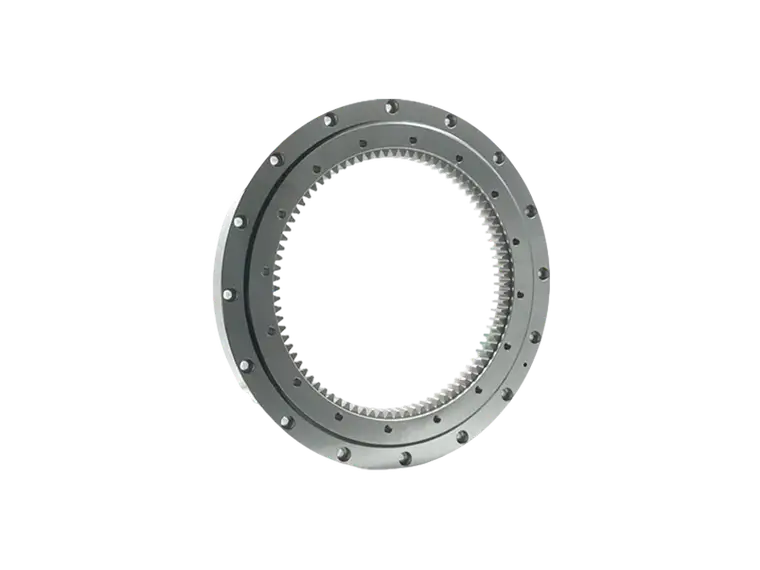
Basic Dynamic Load Rating (los elementos rodantes del cojinete de giro están hechos de acero para cojinetes de carbono-cromo que se endurece en su totalidad)
The basic dynamic load rating represents the constant load under which a group of identical bearings can achieve one million revolutions before the onset of fatigue spalling, con un 90% reliability rate. Para rodamientos de rodillos cruzados, the calculation follows the general roller bearing formula but accounts for the 90-degree cross arrangement:
…
For more detailed information on calculating the load-carrying capacity of crossed roller bearings, por favor haga clic aquí: https://www.prsbearings.com/news/crossed-roller-bearing-load-capacity-calculation/

