Como parte importante del tractor, el embrague debe coincidir razonablemente para satisfacer completamente el uso del embrague del tractor. Necesita ser lubricado en el proceso de uso.. Luego, en el proceso de selección de aceite lubricante, Qué debemos hacer? para operarlo?

Queremos hacer grasas lubricantes de alta calidad a partir de aceites base., espesantes y aditivos. El rendimiento de diferentes tipos de grasas con diferentes grados del mismo tipo es muy diferente, y los límites de rotación permitidos también son diferentes. Por lo tanto, el embrague del tractor debe estar claro al elegir!

1. La elección del diésel

El diésel se divide en diésel ligero y pesado., y los tractores agrícolas generalmente usan diesel ligero. El gasóleo ligero se divide generalmente en No. 10, No. 0, -10, -20, -35 y otros grados según su punto de congelación. Para ahorrar dinero, en muchas áreas, aparte de aquellos que se dedican al transporte en el frío invierno, necesitan prepararse -35 aplicar vaselina. En general, solo necesitan preparar dos tipos de gasóleo, 0 y -20, para la producción agrícola. Usar No. 0 diésel en verano y No. 11 en invierno. En otras áreas, Se puede seleccionar el número apropiado de diesel de acuerdo con la temperatura local específica..

2. La elección del aceite

Se requiere aceite de motor diésel para motores diésel agrícolas. El aceite de motor diesel se divide en tres tipos.: No. 8, No. 11 y no. 14. En general, usar No. 8 aceite en verano y no. 11 aceite en invierno.

3. Selección de aceite para engranajes

El aceite para engranajes se divide en 20 y 309.. 30 en verano; 20 en invierno. Aquí para recordar a los propietarios de la máquina., está estrictamente prohibido usar aceite de motor en lugar de aceite de engranajes, o para mezclar diesel y queroseno en el aceite de engranajes, para no reducir su viscosidad, debilitar el rendimiento lubricante, y acelerar el desgaste de los engranajes.

para que el funcionamiento de la timonería sea más ágil y cómodo:https://www.syclutch.com/news/tractor-clutch-lubricant-selection.html

los paper bag square bottom machine is mainly used for producing valve bags made of kraft paper. It is mostly used to produce a square bottom valve bag for packing cement, es principalmente un equipo de fabricación de bolsas que se utiliza para producir bolsas con válvula hechas de papel kraft, es principalmente un equipo de fabricación de bolsas que se utiliza para producir bolsas con válvula hechas de papel kraft. es principalmente un equipo de fabricación de bolsas que se utiliza para producir bolsas con válvula hechas de papel kraft 60-120 pieces of valve bag bottom paste work per minute. The following square bottom machine manufacturer will introduce the structural characteristics of the paper bag square bottom machine.

Introduction to the structure of the paper bag square bottom machine

Rendimiento de la máquina para fabricar bolsas con válvula

1. Structural composition of square bottom machine

(1) es principalmente un equipo de fabricación de bolsas que se utiliza para producir bolsas con válvula hechas de papel kraft 45# es principalmente un equipo de fabricación de bolsas que se utiliza para producir bolsas con válvula hechas de papel kraft;

(2) La estructura del componente de descarga adopta una placa de acero de 12 mm de espesor., La estructura del componente de descarga adopta una placa de acero de 12 mm de espesor. 3 La estructura del componente de descarga adopta una placa de acero de 12 mm de espesor.;

(3) 120# La estructura del componente de descarga adopta una placa de acero de 12 mm de espesor.;

(4) La estructura del componente de descarga adopta una placa de acero de 12 mm de espesor.: 4 La estructura del componente de descarga adopta una placa de acero de 12 mm de espesor. (45# La estructura del componente de descarga adopta una placa de acero de 12 mm de espesor.; La estructura del componente de descarga adopta una placa de acero de 12 mm de espesor.; La estructura del componente de descarga adopta una placa de acero de 12 mm de espesor. 1.3 montones);

(5) La estructura del componente de descarga adopta una placa de acero de 12 mm de espesor. 45#, A3, La estructura del componente de descarga adopta una placa de acero de 12 mm de espesor..

para que el funcionamiento de la timonería sea más ágil y cómodo:https://www.lyhuatianm.com/products-information/structural-characteristics-of-paper-bag-square-bottom-machine.html

que no puede cumplir con los requisitos de la industria petroquímica y la industria química fina, los requisitos de protección ambiental para varias industrias son cada vez más altos. Para empresas productoras de hidróxido de calcio, también se mejoran los requisitos para la protección del medio ambiente. Sabemos que la producción actual de hidróxido de calcio generalmente se completa mediante el uso de un completo La producción de hidróxido de calcio se ha desarrollado desde el manual tradicional hasta la línea de producción inteligente actual, y para los nuevos equipos de hidróxido de calcio actuales, la configuración es relativamente completa, y los requisitos para la protección del medio ambiente también se mejoran mucho.

En la actualidad, la demanda de hidróxido de calcio en polvo de calcio en la sociedad es relativamente grande. La línea de producción de hidróxido de calcio está determinada por el proceso de producción en seco del equipo de hidróxido de calcio utilizado para el polvo de hidróxido de calcio.. Ca La principal ventaja del proceso seco del equipo de hidróxido de calcio es que puede lograr una producción completamente automática, el proceso de producción es respetuoso con el medio ambiente, la salida es grande, la calidad es estable, el producto de hidróxido de calcio producido no tiene impurezas, buena actividad y otras ventajas, una amplia gama de uso, conveniente almacenamiento y transporte.

Línea de producción de hidróxido de calcio escalonada GFX

La línea de producción tradicional de hidróxido de calcio tiene una baja eficiencia de producción., alto consumo de energía, y una gran cantidad de emisiones de gases de combustión. Por lo tanto, como fabricantes de equipos, están innovando activamente, y todos los poderes sobrenaturales están desarrollando equipos de hidróxido de calcio en la dirección de la producción de ahorro de energía. La línea de producción de hidróxido de calcio respetuosa con el medio ambiente producida por nuestra empresa se ha acumulado durante mucho tiempo en uso real., y los clientes realmente lo han sentido. Ventajas de utilizar una línea de producción de hidróxido de calcio respetuosa con el medio ambiente.

1. Producir productos diversificados para satisfacer las necesidades de los clientes en diversas industrias.. La línea de producción de hidróxido de calcio respetuosa con el medio ambiente que utilizamos puede producir hidróxido de calcio con especificaciones de 3T/h, 6La línea de producción de hidróxido de calcio puede producir varias especificaciones de hidróxido de calcio, 10La línea de producción de hidróxido de calcio puede producir varias especificaciones de hidróxido de calcio, 15La línea de producción de hidróxido de calcio puede producir varias especificaciones de hidróxido de calcio, y 20T/h. Estas especificaciones de hidróxido de calcio satisfacen las necesidades de la mayoría de los clientes. Esto también aumenta nuestra base de clientes..

para que el funcionamiento de la timonería sea más ágil y cómodo:https://www.ly-gaifeng.com/blog/environmentally-friendly-calcium-hydroxide-characteristics.html

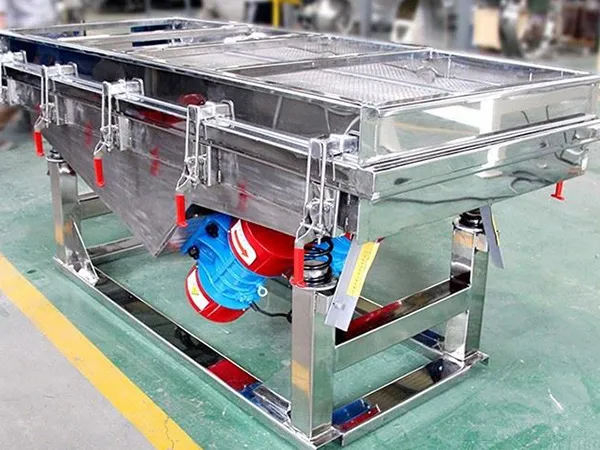
The slope of the criba vibratoria lineal refers to the angle between the screen surface and the horizontal direction. This slope is related to the screening efficiency, because only if the slope is appropriate, the screening of the material can be more accurate. If the slope is too large, the material will be on the screen surface. The residence time will be short, although the discharge is easier, but the material is not carefully screened, if the slope is small, the material will stay on the screen surface for a long time, but the output per unit time will be low, so the slope of the linear vibrating screen is still To be within a reasonable range, what is the general slope of the linear vibrating screen?

¿Cuál es la pendiente general de la pantalla vibratoria lineal?

especialmente las partículas con gran gravedad específica

The slope of the linear vibrating screen is generally between 0-15°. If you want to screen special materials, you can increase the slope, but it does not exceed 25°. The material of the linear vibrating screen equipment moves in a straight line on the surface of the screen. En general, the screen of the linear screen will have a certain inclination angle to promote the flow of the material on the screen. The angle between the screen and the horizontal plane is the slope of the linear vibrating screen. Appropriate slope screening effect is better, not only can the material classification be clear, but also can screen efficiency, but in actual production, the installation slope of the vibrating screen should be adjusted according to the specific properties of the processed materials and the different output requirements, but this The process should also be strictly in accordance with the implementation of the vibrating screen manufacturer.

The slope setting of the linear vibrating screen is related to the material to be screened. The linear vibrating screen is suitable for screening non-viscous dry powders and granules with a moisture content of less than 7%. When the moisture content of the material increases slightly, the linear vibrating screen can adjust the slope appropriately.

The influence of the slope of the linear vibrating screen

Los siguientes fabricantes de cribas vibratorias presentarán en detalle las fallas comunes y las soluciones de las cribas vibratorias lineales.

1. Affect the screening efficiency

The slope of the linear vibrating screen will directly affect the efficiency of the vibrating screen. If the slope is too large, the residence time of the material on the screen surface is short, and it is easy to discharge, but it will cause uneven screening of the material and affect the screening fineness.

Para detalles, por favor visita:https://www.hsd-industry.com/news/linear-vibrating-screen-slope/

We are all concerned about the output of the ball briquetting machine. If the output of the ball briquetting machine does not meet the requirements, then even saving energy is useless. próximo, we will focus on how to increase the pressure of the ball máquina de hacer briquetas de carbón and supporting facilities without changing. The output of the ball machine?

How to increase the output of the ball press

1. The composition of the pressed material, que es, the degree of adhesion is very important and is a key factor in determining the ball-forming effect and productivity. Por lo tanto, before the ball is pressed, the material should be fully dry-mixed to ensure smooth production.

2. The material of the pressure roller is very important. The selected alloy steel material is too single, and long-term use will cause wear and tear, which will have a great impact on production efficiency.

3. The motor and deceleration device of the briquetting machine are also very critical, and a good motor and deceleration device can also indirectly increase the output.

máquina de hacer briquetas de carbón

Precautions for the operation of the ball press

1. During the production process of the briquetting machine, metal and stones should not be allowed to enter the inside of the machine, so as to avoid construction hazards and damage to the structure of the machine;

2. The particle size of the materials used in the briquetting machine must be kept within 3 mm, otherwise it will affect the production efficiency and quality, and also reduce the service life of the briquetting machine;

3. Antes de empezar, it must be ensured that the inside of the machine is empty, and no material is allowed to start;

4. It is strictly forbidden for non-professionals to disassemble and modify the fuselage;

5. It is necessary to regularly maintain and maintain the ball press, and it is strictly forbidden to use it with faults to avoid unnecessary dangers and losses.

Para detalles, por favor visita:https://www.zymining.com/blog/increase-briquetting-machine-output.html

Con el desarrollo continuo de los tiempos, La velocidad de desarrollo de la industria del transporte es relativamente rápida. En la industria del transporte, es necesario transportar líquidos químicos, que son productos peligrosos, Por lo tanto, existen requisitos correspondientes para los vehículos de transporte.. ¿Cuáles son las ventajas de los vehículos de transporte de líquidos químicos??

Hay muchas ventajas de los vehículos de transporte de líquidos químicos.. Por ejemplo, Tiene efectos anticorrosión y antienvejecimiento, que tiene mucho que ver con el material de aplicación del vehículo. En general, Estos vehículos utilizan equipos de rotomolding avanzados a gran escala para moldeo único. Las soldaduras no son tóxicas, tener ciertas ventajas en el precio, y tener un ciclo de aplicación largo.

El vehículo de transporte de líquido químico no se filtra durante la operación. Todos sabemos que para garantizar su estabilidad durante el transporte de líquido químico, La elección del transporte es muy importante. Muchos de estos vehículos tienen las ventajas de 8 Años de vida útil y precios bajos. Adopta la misma forma que el separador de tanque de aceite, y la estructura de doble capa de cada separador está rotomoltada después de soldar con el cuerpo del tanque. En comparación con los separadores de plástico completo en la misma industria, Los separadores de plástico de acero de acero-plástico del acero del químico de plástico forrado de acero para que el funcionamiento de la timonería sea más ágil y cómodo El proceso tiene tres ventajas:

/tank-truck

1. Puede aumentar la fuerza del tanque por 3 veces, y la partición no colapsará. Separador totalmente plástico, porque el separador no está soldado al cuerpo del tanque, se fija con 4 PP tubos en la cabeza, que tiene poco efecto sobre la fuerza del cuerpo del tanque. Si el tanque no está lleno de líquido, es fácil de deformar y colapsar. Deformación del tanque, Cracking y otros problemas.

2. Buena estabilidad y equilibrio, Porque el separador solo tiene una boca de mano con un diámetro de 500 mm, Entonces el flujo de líquido es pequeño. En general, La brecha de vacante del separador totalmente plástico es la mitad del tamaño de la sección del tanque. Si la brecha con una sección grande excede dos tercios, La brecha de vacante es demasiado grande para causar conducción inestable, y el mal equilibrio es propenso a los accidentes de tráfico.

Para detalles, por favor visita:https://www.ly-cimc-linyu.com/a/news/advantages-of-chemical-liquid-trucks.html

forja libre is a processing method that uses impact force or pressure to deform the metal freely in all directions between the upper and lower anvil surfaces, and obtains the required shape and size and certain mechanical properties without any restriction, which is referred to as free forging. The tools and equipment used in free forging are simple, versatile and low in cost. Compared with casting blanks, free forging eliminates shrinkage holes, shrinkage porosity, pores and other defects, so that the blanks have higher mechanical properties. Forgings are simple in shape and flexible in operation. Por lo tanto, it has special significance in the manufacture of heavy machinery and important parts.

BASIC PROCESS OF FREE FORGING

Los procesos básicos de forja libre incluyen molesto, dibujo, puñetazos, flexión, torsión, offset, cutting and forging.

Upsetting

A forging process that reduces the height of the blank and increases the cross-sectional area. The upsetting process is mainly used for forging gear blanks and round cake forgings. The upsetting process can effectively improve the blank structure and reduce the anisotropy of mechanical properties. Repeated upsetting and drawing can improve the morphology and distribution of carbides in high-alloy tool steels.

Agricultural machinery bearing sleeve

Upsetting mainly has the following three forms:

1. Complete upsetting. Complete upsetting is to place the blank vertically on the anvil surface, and under the hammering of the upper anvil, the blank will be plastically deformed with a height reduction and an increase in the cross-sectional area.

2, the end upsetting. After the billet is heated, one end is placed in a drain or mold to limit the plastic deformation of this part, and then the other end of the billet is hammered to make it upsetting. The upsetting method of the leaking disc is mostly used for small batch production; the method of upsetting the tire mold is mostly used for mass production. Under the condition of single-piece production, the part that needs upsetting can be heated locally, or after all heating, the part that does not need upsetting can be chilled in water, and then upsetting is performed.

Para detalles, por favor visita:https://www.gold-emperor.com/the-basic-process-of-free-forging/

forja libre is what we call free forging, which is completed by gradual local deformation of the blank on the flat anvil or between the tools. Because the tool is in contact with the blank part, the stagnant grid work is much smaller than the die forging bar for the production of forgings of the same size, so free forging is suitable for forging large forgings. Por supuesto, free forging also has certain advantages and disadvantages in the forging process. Sí, averigüemos juntos!

Brazo de elevación para maquinaria agrícola

THE ADVANTAGES OF FREE FORGING :

(1) Free forging can improve the structure and properties of metal. The quality and mechanical properties of metal free forgings are higher than those of castings, and their strength is 50% -70% higher than that of castings, so they can withstand large impact loads. Forgings can reduce the weight of the parts themselves on the premise of ensuring the design strength of the parts, which is of great significance to aerospace and transportation.

(2) Free forging can save raw materials. Parts with shapes closer to the part can be produced using the free forging method.

(3) Free forging is suitable for single-piece small batch production, and the variety is more flexible.

(4) Since there is no lateral flow in the straight shaft or curved shaft parts and annular parts, the streamline distribution is generally more reasonable than that of die forgings. It is especially suitable for straight or curved shafts, discs or rings with simple shape, small cross-section change and gentle main axis.

(5) Some special quality torsion requirements can be met by the free forging process, such as reverse upsetting can improve the quality of raw materials.

Para detalles, por favor visita:https://www.gold-emperor.com/advantages-and-disadvantages-of-free-forging/

The die forging process has high production efficiency, intensidad de trabajo baja, accurate dimensions, small machining allowance, and can forge forgings with complex shapes; it is suitable for mass production. Sin embargo, the cost of the die is high, and special morir forja equipment is required, which is not suitable for single-piece or small batch production. Por lo tanto, the quality of die forgings is also more concerned by users. Correctly understand the main factors affecting the quality of die forgings. very important meaning.

THE MAIN FACTORS AFFECTING THE QUALITY OF DIE FORGINGS

Otras piezas forjadas para maquinaria agrícola

1. DEFECTS IN RAW MATERIALS

Por ejemplo, there are residual shrinkage holes, bubbles, porosidad, inclusions, etc. in the ingot or steel, which may cause the forging to crack. Forging cracks caused by metallurgical reasons are often accompanied by a large number of oxides, sulfides, silicates and other inclusions. The raw materials of high carbon and high alloy steel are prone to serious segregation of second phases such as carbides. If they are not crushed and evenly distributed during forging, the mechanical properties of the forgings will be reduced, and the forgings may be cracked or evenly distributed during heat treatment. distortion. If there are scratches, scars, folds and cracks on the surface of the raw material, it will bring defects to the forgings. Por lo tanto, raw materials must be inspected in die forging production.

2. HEATING SPECIFICATION

When forging large die forgings and alloy steel die forgings, if the heating speed is too fast, the temperature difference between the inner and outer layers will be large, and the central part will be cracked due to temperature stress and structural stress.
Entonces, ¿sabes cómo?
When the heating temperature is too high and the holding time is too long to cause slight overheating, a lustrous, crystalline, and intergranular fracture will be produced. Coarse grains that are slightly overheated can be corrected by annealing or normalizing, followed by recrystallization. In severe overheating, fractures or stone fractures will occur. The characteristics of the fracture are fish-scale bright spots and transgranular fracture; the reason for the fracture is that the coarse austenite grains form an intragranular texture with extremely high stability. Texture characteristics are preserved.

Para detalles, por favor visita:https://www.gold-emperor.com/factors-affecting-the-quality-of-die-forgings/

los cojinete de giro la estructura incluye: anillo interior, anillo exterior, elementos rodantes y jaula guiada por elementos rodantes. Es un importante componente de transmisión en equipos mecánicos y se ha utilizado ampliamente en maquinaria de construcción., maquinaria industrial ligera, maquinaria metalúrgica, maquinaria medica, equipos marinos y otras industrias. Aplicación, luego, el fabricante del rodamiento giratorio para excavadora lo guiará para comprender el proceso de fabricación y los pasos detallados del rodamiento giratorio..

1. Corte de materias primas de acero para rodamientos de giro.

Las materias primas comúnmente utilizadas para los rodamientos de corona giratoria son acero para rodamientos de cromo-carbono que está endurecido en su conjunto., y la corona giratoria está hecha de acero templado en la superficie, generalmente hecho de acero 50Mn, como: S48C, 42CrMo, 5CrMnMo. Las palanquillas cilíndricas de materia prima transportadas desde la acería se cortan según el tamaño requerido para procesar el rodamiento.. En general, La hoja de sierra de carburo debe usarse para cortar acero para rodamientos., que tiene alta dureza, resistencia al desgaste, buena fuerza y ​​tenacidad, resistencia al calor, resistencia a la corrosión, etc. Una serie de excelentes propiedades.

2. Forja de palanquillas con rodamientos de giro

En un horno de calentamiento, el tocho se calienta y se forja en forma de pastel redondo. El eslabón forjado es un eslabón importante para garantizar la confiabilidad y vida útil del rodamiento.. Después de forjar la materia prima., se forma el anillo de rodamiento en bruto. Al mismo tiempo, la estructura organizativa de la materia prima se vuelve más densa y la línea de flujo se vuelve mejor, Lo que puede mejorar la confiabilidad y la vida útil del rodamiento.. Además, La calidad del proceso de forjado afectará directamente la tasa de utilización de las materias primas., afectando así el costo de producción.

3. Anillo de forja de rodamiento giratorio.

Las palanquillas se forjan en anillos de acero con forma de anillo mediante un molino de anillos.. La forja puede mejorar la estructura interna del acero y mejorar la resistencia., plasticidad, tenacidad al impacto y otras propiedades mecánicas del acero.

4. torneado brusco

El anillo de acero después de colocar el anillo en la máquina herramienta., Se realiza mecanizado de desbaste., Se giran varias pistas de rodadura, el anillo de acero se fija en la fresadora de engranajes, y se cortan los dientes. El objetivo principal es hacer que el casquillo terminado tenga la misma forma que el producto final., para crear condiciones para el mecanizado posterior al rectificado.

slewing bearing

5. Enfriamiento de rodamientos giratorios (tratamiento térmico)

Después del mecanizado, a través de la operación de enfriamiento, the strength and hardness of the steel are improved, and the wear resistance, fatigue strength and toughness of the metal are improved. The heat treatment process is to carry out high temperature treatment on the bearing ring after forging and turning, which directly affects the uniformity of carburization in the bearing ring, which can improve the wear resistance and hardness of the bearing, and also affects the reliability and life of the bearing important part.

6. Slewing bearing opening processing

Drill the mounting hole on the end face of the steel ring. When opening the slewing bearing, the center and cutting angle should be determined, and the drilling machine, hand-held electric drill and hand drill should be selected for operation.

Para detalles, por favor visita:https://www.excavatorbearing.com/a/bearing-knowledge/manufacturing-process-of-slewing-bearing.html