
Crossed roller bearings are often specified when a single bearing must handle radial load, axial load and tilting moment at the same time, which is why they appear in rotary tables, суставы робота, indexing heads and metrology stages. Because these applications live or die by positioning accuracy, the accuracy grade on the datasheet becomes a buying decision rather than a footnote. Yet the grade alone does not determine how the assembly performs. This guide explains what the tolerance classes actually control, how the common designation systems map to one another, and how to match a grade to a real machine requirement without paying for precision the structure cannot use.
What an Accuracy Grade Actually Defines
A crossed roller bearing accuracy grade is a set of permitted deviations, not a statement about load capacity or stiffness. Two bearings of the same size, one in P6 and one in P4, can carry identical loads; what differs is how closely the finished rings conform to ideal geometry after hardening and grinding.
The tolerance parameters that change
- Inner and outer ring radial runout — the wobble of the raceway relative to its own bore or outside diameter.
- Axial runout of the face — the error that directly influences tilt and face-out measurement in a rotary table.
- Bore and outside diameter dimensional tolerance — controls fit and, следовательно, interference or clearance in the housing.
- Width and shoulder tolerances — affect how roller sets in multi-row or paired arrangements line up.
- Running parallelism and torque variation — often quoted for crossed roller types because uneven torque shows up as ripple in a servo loop.
Tighter grades compress all of these deviations. На практике, each successive grade step at the same bore size typically tightens permitted runout by roughly a factor of two, which is why the cost curve is not linear.
Reading the Designation Systems on a Datasheet
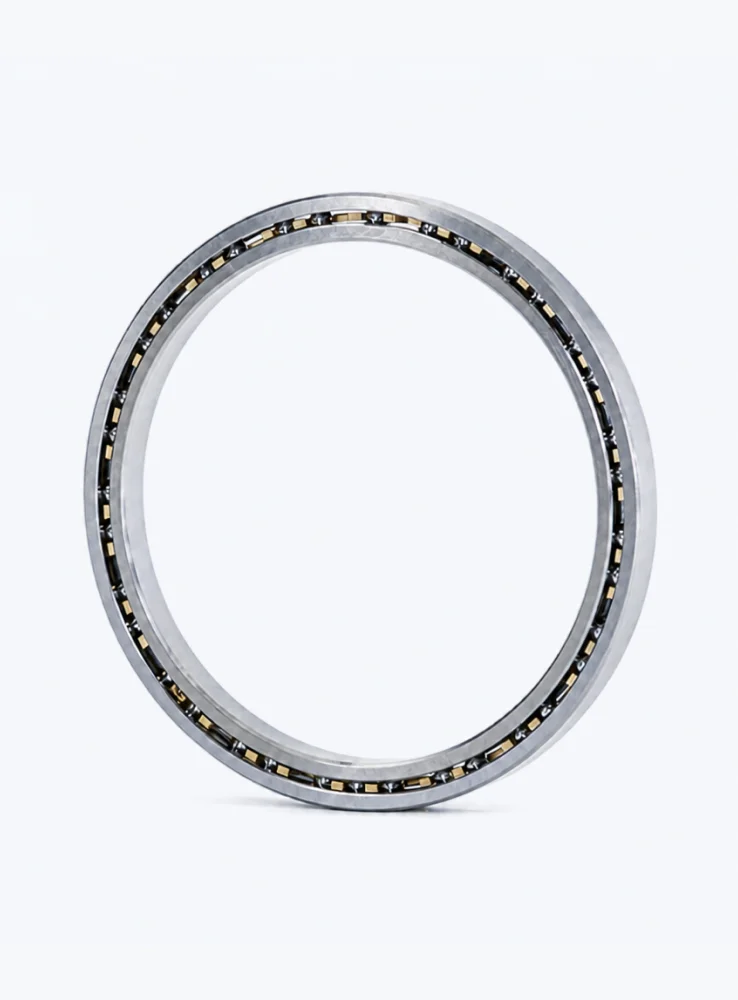
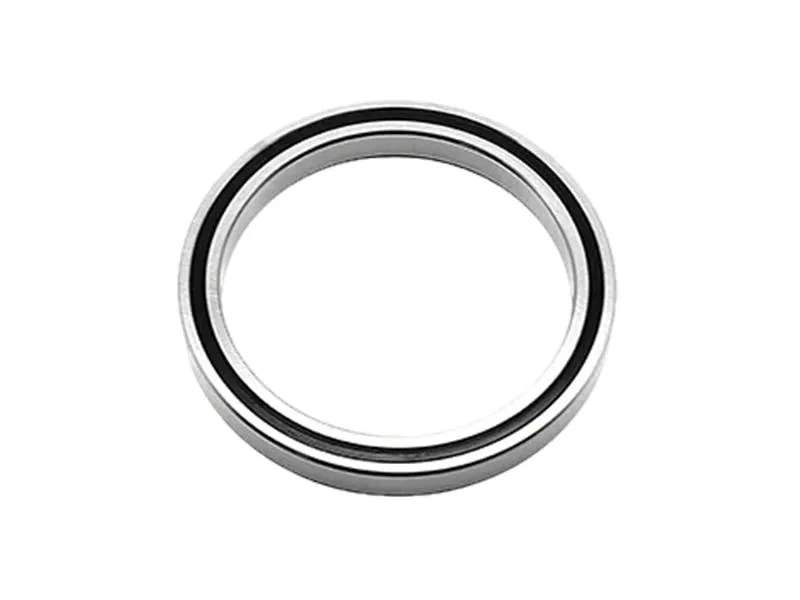
Suppliers use several overlapping systems, and mixing them up is a common source of over- или не соответствует спецификации. Crossed roller bearings are roller bearings, so ball-bearing classes such as ABEC 7 or ABEC 9 do not strictly apply to them, even though the numbers are sometimes printed in marketing materials.
- ИСО 492 / ОТ 620 — the P-classes: P6 (normal), P5, P4 and P2, from loosest to tightest.
- JIS B 1514 — classes 0, 6, 5, 4 и 2, which correspond closely to the ISO P-classes.
- ЭКАБ / RBEC — the Annular Bearing Engineers’ Committee scale, technically written for ball bearings; RBEC is the roller equivalent used in North America.
- Manufacturer-specific codes — some makers add suffixes for preload, special clearance or matched sets, which sit outside the grade system entirely.
…
For more detailed information on selecting the precision grade for crossed roller bearings, пожалуйста, нажмите здесь: https://www.bobibearing.com/a/bearing-knowledge/accuracy-grades.html
