
Подшипники с перекрестными роликами are often specified precisely because they solve a difficult design problem: they carry radial, axial and moment loads at the same time while holding tight runout tolerances. That performance comes from a small number of rollers whose surfaces cross each other in a single raceway, which means the lubricant film is the only thing separating metal from metal at several critical contact points. A large share of failures reported as fatigue or overload are in fact lubrication failures — the wrong grease, too much of it, too little of it, or a film that was never re-established after mounting. The guidance below covers what actually determines lubrication performance in crossed roller bearings and how to convert it into predictable service life.
Why Lubrication Has an Outsized Effect on Crossed Roller Bearings
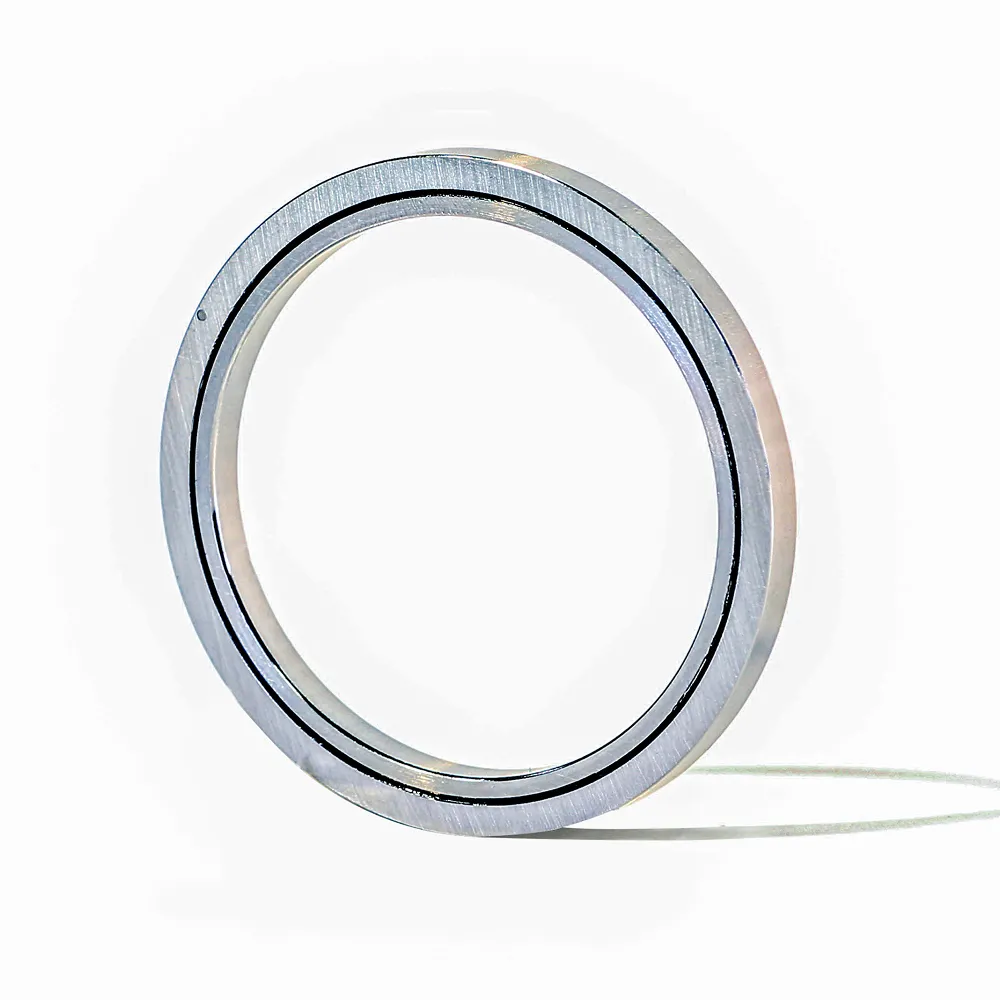
In a conventional radial bearing, rollers stay parallel and load is distributed along predictable lines. В скрещенном роликоподшипнике, cylindrical rollers are arranged at 90 degrees to one another in a single V-shaped raceway. Each roller contacts the raceway along a line, and adjacent rollers touch at their crossing points in sliding rather than rolling motion. The result is a compact, very stiff bearing — and a lubrication regime with more sliding contact than most engineers expect.
What the lubricant must actually do
- Maintain a separating film between the roller bodies and the raceway under combined radial, axial and tilting loads.
- Reduce friction and wear at the roller-to-roller crossing contacts and inside the cage pockets.
- Carry heat away from the contact zones, particularly in continuous-duty indexing tables and rotary stages.
- Protect finely ground raceway and roller surfaces from corrosion during operation, downtime and storage.
- Act as a barrier in grease-lubricated designs, keeping fine particles and coolant mist out of the raceway.
When any of these functions degrades, the first symptoms are usually a slow rise in running torque and operating temperature, followed by visible fretting or false brinelling on the raceway. By the time audible noise appears, the surface damage is already established.
Choosing the Right Lubricant for the Application
Grease or oil
Most crossed roller bearings in machine tools, robotics and medical equipment are grease lubricated because grease stays in place, simplifies sealing and requires less maintenance infrastructure. Oil is preferred where speed is high, where heat must be removed efficiently, or where the bearing is part of a centralized lubrication system. As a working rule, grease suits moderate speed and oscillating or indexing motion; circulating oil suits continuous high-speed rotation and heavy thermal load.
…
For more details on lubrication techniques for crossed roller bearings and how to extend their service life, пожалуйста, нажмите здесь: https://www.bobibearing.com/a/bearing-knowledge/lubrication-tips-for-crossed-roller-bearings.html
