
Custom steel office furniture is rarely just a question of dimensions. When procurement teams or facility managers start requesting quotations, what they are really trying to establish is whether a supplier can hold a structural standard, a finish standard and a delivery commitment consistently over years of daily use. Steel furniture can feel anything but industrial — warm, quiet and precisely fitted to a space — but only when every specification is agreed in advance and verified at the factory. The points below outline the decisions that must be settled before an order is placed, and how each one affects price, durability and lead time.
What Custom Steel Office Furniture Actually Covers
The word custom means different things to different factories. Some treat it as a size adjustment on a standard cabinet; others treat it as a ground-up design exercise. Aligning on scope is the first step, because it determines tooling cost and lead time.
- Dimensional fit — depth, height and corner treatments adapted to a specific floor plan, including tight service elevators, sloped ceilings or non-standard room heights.
- Configuration — number of doors and drawers, opening direction, shelf positions, lock type, fixed or mobile base.
- Material — cold-rolled steel, galvanized steel or stainless steel, with a defined panel thickness and internal reinforcement.
- Color and finish — powder coating matched to a RAL reference, texture level, gloss or matte, and anti-fingerprint treatment.
- Hardware and accessories — cable cutouts, grommets, locks, label holders, leveling feet and mounting interfaces.
Writing the scope down forces decisions early. It also makes later quotations comparable, which is where most budget overruns begin.
Steel and Structure: The Decisions That Determine Service Life
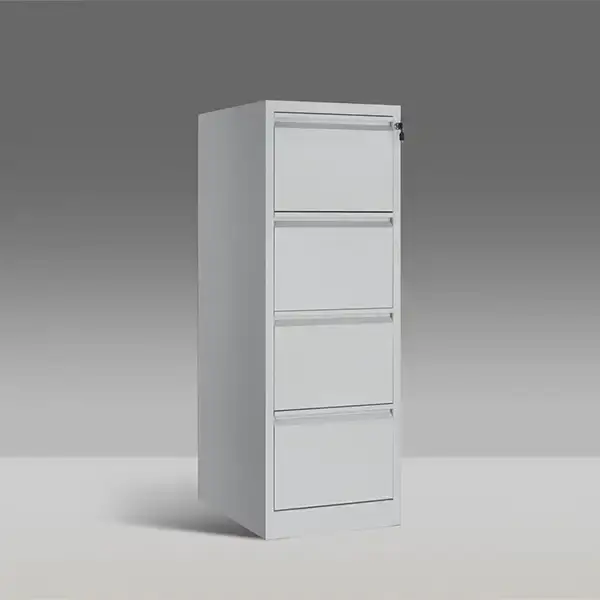
Sheet Thickness and Grade
Thickness is the single most consequential specification in a steel furniture quotation, and the easiest one to quietly reduce. Cabinet bodies and doors commonly sit between 0.6 mm and 1.0 mm, while load-bearing shelves, work surfaces and moving parts need more. A thinner panel does not fail immediately; it flexes, then sags, then refuses to align at the door gap. Grade matters less than consistency: a well-bent, properly reinforced assembly in a mid-range steel will usually outperform a thin assembly in a premium grade. Ask suppliers to state thickness by component, not as a general claim.
Welding, Bending and Load Testing
How a cabinet is joined reveals more about build quality than any marketing claim. Spot welding is acceptable in concealed, non-structural positions; continuous welding or reinforced bends belong wherever load is transferred. For shelving and tambour or sliding systems, request static load figures and cycle-test results. A supplier who measures their own products will answer this immediately. One who does not will describe them as heavy duty instead.
Surface Treatment and Corrosion Resistance
Powder coating performance depends on preparation rather than on the powder itself. Degreasing, phosphating and thorough rinsing before coating determine whether the finish survives cleaning chemicals, humidity and daily contact. Coating thickness is typically measured in the 60–80 micron range for office furniture, and salt-spray test results should be available on request. If the furniture will sit near windows, kitchens or humid climate zones, specify the applicable test duration and confirm that edges and cutouts receive the same treatment as flat panels. Uncoated edges are the most common starting point for rust.
…
For more detailed information on factors to consider when customizing steel office furniture, please click here: https://www.lakshyofurniture.com/news-center/custom-steel-desk/
