
Improving the efficiency of a welding manipulator (often a robotic arm or a dedicated positioner used in automated or semi-automated welding) involves optimizing various aspects of the system and process.
How to improve the efficiency of welding manipulator
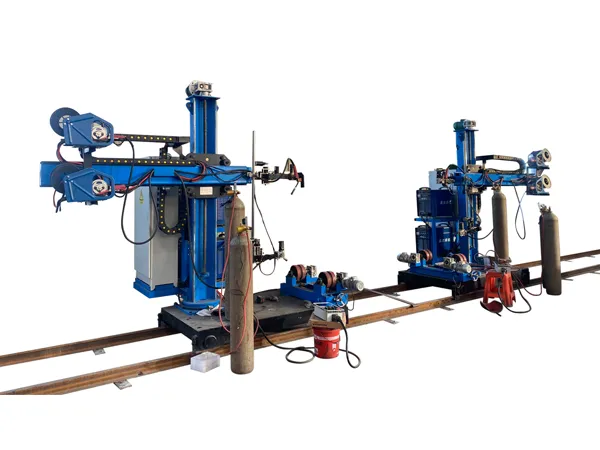
Programming and Path Optimization:
Minimize Air Time: Reduce the time the manipulator spends moving between welds (“air cutting”). Optimize the path planning to take the shortest, fastest routes between weld points.
Optimize Motion Speeds: Use the highest safe and repeatable speeds for non-welding movements. Tune acceleration and deceleration parameters.
Weld Sequence Optimization: Plan the order of welds to minimize overall manipulator travel, reduce heat distortion (which can necessitate rework or slower welding later), and maintain optimal torch angles.
Offline Programming (OLP): Use OLP software to create, simulate, and optimize programs without stopping the production line. This maximizes manipulator uptime.
Use Appropriate Motion Types: Employ linear movements (L) for welding paths and joint movements (J) for faster transitions between distant points where path accuracy isn’t critical.
Welding Process Optimization:
Optimize Weld Parameters: Fine-tune voltage, wire feed speed (amperage), travel speed, and gas flow for maximum deposition rate and minimal spatter/defects, reducing post-weld cleaning and rework.
Select Efficient Welding Processes: Consider advanced processes like pulsed MIG/MAG, CMT (Cold Metal Transfer), or high-speed TIG variants if applicable, as they can offer higher speeds, lower heat input, or reduced spatter.
Improve Torch Angle and Stick-out: Ensure the torch angle and contact-tip-to-work distance (stick-out) are optimized and consistently maintained for stable arc and good penetration.
Fixturing and Part Presentation:
Design for Automation (DFA): If possible, influence part design to improve accessibility for the manipulator and simplify weld joints.
High-Quality, Repeatable Fixtures: Use fixtures that locate parts accurately and consistently every time. Poor fit-up is a major cause of inefficiency and weld defects.
Quick Changeovers: Design or utilize fixtures that allow for fast loading and unloading of parts. Consider indexing tables or dual fixture setups where one side can be loaded/unloaded while the other is being welded.
Optimize Fixture Access: Ensure the fixture provides clear access for the manipulator arm and welding torch without collisions.
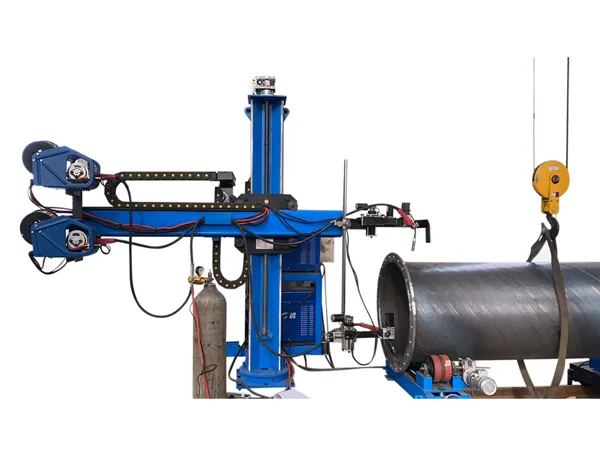
Sensing and Adaptive Control:
Touch Sensing: Use the welding wire or a probe to accurately locate the start of weld joints, compensating for minor part variations.
Through-Arc Seam Tracking (TAST): For suitable joints, use TAST to allow the robot to follow the weld seam automatically, compensating for variations during welding.
…
For more detailed information on how to improve the efficiency of welding operators, please click here: https://www.bota-weld.com/en/a/news/improvement-of-welding-manipulator-work-efficiency.html

