
Slim-type crossed roller bearings have become a preferred solution in industries that demand high precision, compact design, and reliable load performance. Engineers who work with robotics, automation systems, medical devices, and CNC equipment often select these bearings because they deliver exceptional rigidity while maintaining a slim profile. However, many users still struggle to fully understand how load capacity works in these specialized bearings and how to select the right model for their application.
This guide explains the load capacity of slim-type crossed roller bearings in a clear, practical, and experience-driven way. It focuses on real engineering considerations rather than textbook definitions, helping you make informed decisions that improve equipment performance and service life.
What Are Slim-Type Crossed Roller Bearings?
Slim-type crossed roller bearings are a variation of crossed roller bearings designed with a reduced cross-section. Manufacturers arrange cylindrical rollers orthogonally (at 90 degrees) between inner and outer rings. This structure allows a single bearing to simultaneously handle radial loads, axial loads, and moment loads.
Unlike traditional bearings that require multiple units to support different load directions, slim-type crossed roller bearings simplify system design. Their compact structure makes them ideal for applications where space and weight constraints are critical.
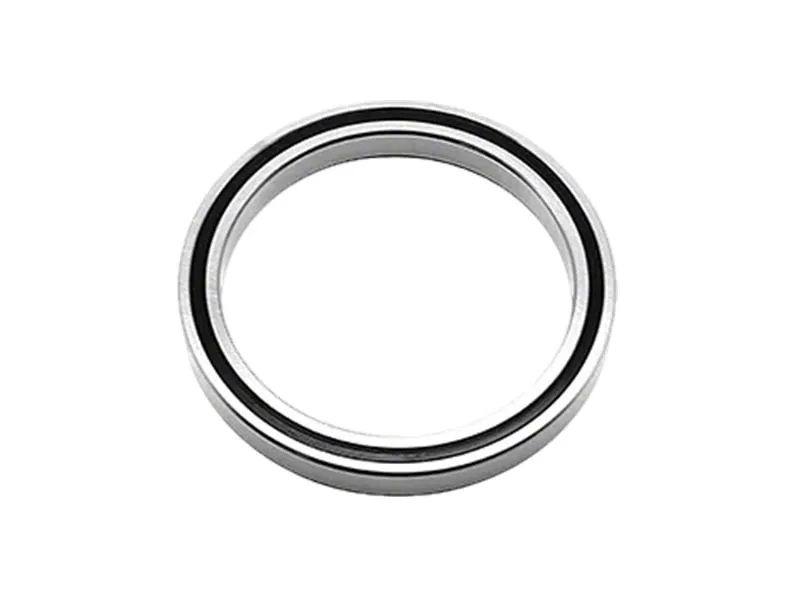
Load Capacity of Slim-Type Crossed Roller Bearings
Load capacity is not a single fixed value. Engineers typically evaluate it through two main parameters:
Dynamic Load Capacity (C): This value represents the load a bearing can handle during rotation over a defined lifespan.
Static Load Capacity (C₀): This value indicates the maximum load a bearing can withstand without permanent deformation when stationary.
Slim-type crossed roller bearings often show high load capacity relative to their size. However, actual performance depends heavily on operating conditions, installation accuracy, and load distribution.
Key Factors That Affect Load Capacity
1. Bearing Geometry and Roller Arrangement
The crossed arrangement of rollers ensures that load is distributed evenly across multiple contact points. This design significantly increases rigidity and load-bearing capability compared to standard ball bearings.
Slim-type designs, however, reduce material thickness. Engineers must balance compactness with strength. A thinner ring structure may slightly reduce absolute load capacity, but optimized internal geometry compensates for this in most applications.
2. Material Quality and Heat Treatment
High-quality bearing steel and precise heat treatment processes directly influence load capacity. Manufacturers who control hardness, residual stress, and microstructure can significantly enhance fatigue resistance.
In real-world applications, bearings made with inferior materials often fail prematurely, even if their catalog load ratings appear similar. This is why sourcing from reliable manufacturers is critical for long-term performance.
…
To learn more about how to calculate the load capacity of slim crossed roller bearings and what factors affect load capacity, please click to visit: https://www.prsbearings.com/a/news/load-capacity-of-slim-type-crossed-roller-bearings.html

