
In high-temperature melting processes, crucible failure is not just a maintenance issue—it directly impacts production continuity, energy efficiency, and material quality. Silicon carbide (SiC) coated crucibles have gained significant traction because they consistently deliver 3–5 times longer service life than uncoated alternatives. But what exactly makes the coating so effective? This article breaks down the material science and engineering principles behind SiC-coated crucibles, helping you make an informed procurement decision. Cangzhou Carbon specializes in manufacturing these advanced crucibles for demanding industrial applications.
How Silicon Carbide Coating Protects the Crucible Matrix
A crucible’s life is primarily limited by three failure mechanisms: thermal shock cracking, chemical erosion from molten metals or fluxes, and mechanical abrasion from charge materials. Silicon carbide coatings address all three simultaneously by creating a dense, chemically inert barrier on the crucible surface.
Thermal Conductivity and Thermal Shock Resistance
Silicon carbide has a thermal conductivity of approximately 120 W/(m·K) at room temperature, significantly higher than typical clay-graphite or alumina crucibles (15–30 W/(m·K)). This high conductivity evenly distributes heat across the crucible wall, reducing localized thermal gradients that cause cracking. Moreover, the coating’s coefficient of thermal expansion (CTE) closely matches that of the base substrate—often a carbon-bonded silicon carbide or clay-graphite body—minimizing interfacial stress during rapid heating or cooling cycles. Reduced thermal stress directly translates to fewer micro-cracks and longer operational life.
Chemical Barrier Against Slag and Flux Attack
Molten metals such as aluminum, copper, and zinc contain aggressive fluxes (e.g., chlorides, fluorides) that chemically attack the crucible’s binder phase. Uncoated crucibles suffer from progressive penetration of these fluxes into the porous structure, leading to spalling and weight loss. The SiC coating, applied via a specialized slurry or CVD process, forms a non-wettable, impermeable layer that resists chemical dissolution. Even at 900°C molten aluminum contact, the coating maintains its integrity, as confirmed by numerous industrial test reports.
Comparison: Coated vs. Uncoated Crucible Failure Modes
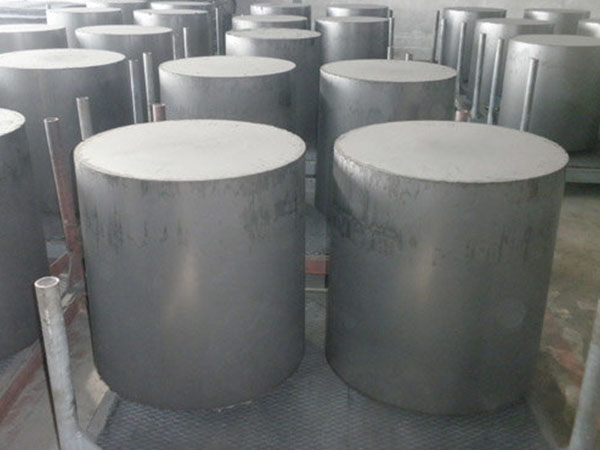
The graph below summarizes typical failure rates observed in non-ferrous melting foundries. Cangzhou Carbon’s internal testing shows consistent trends:
| Failure Mechanism | Uncoated Crucible (Avg. Life 30–45 days) | SiC-Coated Crucible (Avg. Life 120–180 days) |
| Thermal shock cracking | 40% of failures | 15% of failures |
| Chemical erosion / pitting | 35% of failures | 10% of failures |
| Mechanical abrasion / wear | 15% of failures | 30% of failures (still tolerable) |
| Other (oxidation, deformation) | 10% of failures | 45% of failures (end-of-life wear-out) |
The data clearly shows that the coating shifts failure from early catastrophic cracking/erosion to gradual mechanical wear, enabling predictable replacement schedules. Cangzhou Carbon optimizes coating thickness (typically 0.5–1.5 mm) to balance cost and longevity for specific melting applications.
…
For more information on why silicon carbide-coated crucibles have a longer service life during the smelting process, please click to visit:https://www.czgraphite.com/a/news/sic-crucible-durabil.html

