
Welding defects in tower sections remain one of the most costly and time-consuming challenges in wind turbine manufacturing. Inconsistent penetration, porosity, and distortion not only increase rework expenses but also compromise the long-term structural integrity of towers. A proven solution lies in synced rotation—coordinating the rotational speed of the tower section with the welding torch movement. When implemented correctly, this technique eliminates uneven heat distribution, reduces residual stress, and ensures uniform weld bead geometry. BOTA has developed advanced turnkey systems that make synced rotation practical and repeatable for production environments.
The Critical Impact of Weld Defects in Tower Section Manufacturing
Tower sections are among the largest and most heavily loaded components in a wind turbine. A single defect—such as lack of fusion, undercut, or centerline cracking—can lead to premature fatigue failure. The consequences include costly field repairs, extended downtime, and potential safety risks. In high-volume fabrication, even a minor defect rate of 2% can translate into hundreds of hours of grinding, welding, and inspection labor per year. The welding process itself introduces thermal cycles that vary with section thickness, joint design, and heat input. Traditional static welding (where the section remains fixed while the welding head moves) inherently creates an asymmetric thermal profile: the lead side of the weld pool experiences different cooling rates than the trailing side. This asymmetry is a primary driver of angular distortion, excessive convexity, and incomplete sidewall fusion.
By contrast, synced rotation aligns the axis of welding travel with the part rotation, making the heat input symmetrical around the circumference. This simple yet powerful change addresses the root cause of many common defects.
How Synced Rotation Eliminates Common Weld Defects
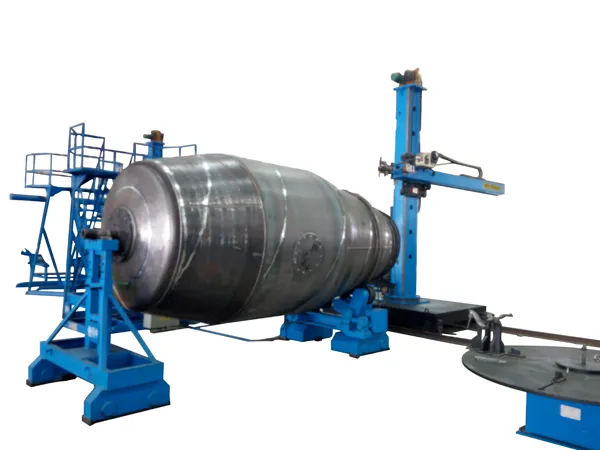
The key mechanism behind synced rotation is the elimination of the relative motion between the welding torch and the workpiece that occurs in the “orbital” or “fixed-torch” methods. In a typical orbital welding setup, the torch moves around a stationary cylinder, constantly changing its angle relative to gravity. This variation alters the puddle shape and can lead to sagging or unstable arc behavior. Synced rotation, on the other hand, keeps the torch fixed in the 12 o’clock or 2 o’clock position while the tower section rotates beneath it. The result is a consistent working angle and a stable molten pool throughout the entire weld pass.
Uniform Heat Input and Controlled Cooling
When the section rotates at a constant speed matched to the desired travel speed, every point on the weld joint experiences the same heat input per unit length. This uniformity directly reduces the risk of hot cracking (which occurs when the cooling rate is too fast) and brittle zones (caused by slow cooling). The controlled rotation also allows the use of higher deposition rates without sacrificing quality, because the heat can be better managed. BOTA’s precision rotation controllers maintain rotational speed within ±0.1% of setpoint, ensuring repeatable bead geometry across hundreds of sections.
…
For more detailed information on reducing welding defects in tower sections through synchronous rotation, please click here: https://www.bota-weld.com/en/a/news/weld-defects-reduction.html
