
When a design calls for a bearing that can carry heavy radial loads, axial loads and often a tilting moment inside a compact envelope, two candidates usually make the shortlist: crossed roller bearings and tapered roller bearings. Both use line contact between rolling elements and raceways, so both outperform ball bearings of similar size in load capacity and rigidity. The similarity ends there, however. The two designs differ in geometry, load direction, mounting practice, achievable accuracy and cost — and choosing the wrong one leads to premature wear, poor positioning accuracy or an unnecessarily expensive assembly. This comparison walks through the practical differences that matter at the design stage.
How the Two Bearings Are Constructed
Understanding the geometry explains almost every performance difference that follows.
Crossed roller bearings
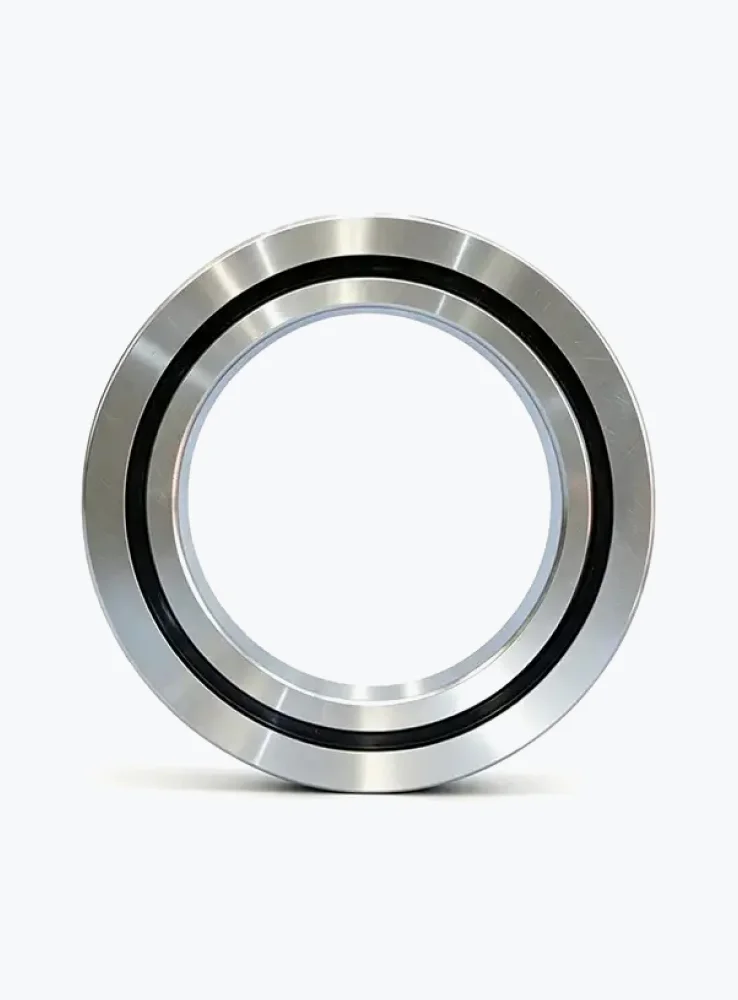
Cylindrical rollers are arranged in a single raceway and alternate at 90 degrees to one another, so each adjacent roller contacts the raceway at a different angle. Spacers or a cage keep the rollers separated and prevent skewing. Because the rollers cross, one bearing set can resist loads from multiple directions simultaneously, and the overall height of the assembly stays low relative to its diameter.
Tapered roller bearings
Rollers are conical, and the raceway surfaces are tapered so that all contact lines converge at a common apex on the shaft axis. This geometry produces true rolling motion with minimal sliding. A single-row tapered roller bearing carries radial load plus axial load in one direction only; reversing axial load requires a second bearing mounted in opposition. The inner ring and roller assembly is normally separable from the outer ring, which simplifies inspection and mounting.
Load Capacity and Load Direction
This is the single most important selection criterion, and the two types are not interchangeable here.
- Crossed roller bearings: handle radial load, axial load in both directions, and tilting moment in one bearing. Capacity is shared between directions rather than concentrated in one, so radial capacity is moderate compared with a tapered bearing of the same envelope.
- Tapered roller bearings: offer very high radial capacity and substantial axial capacity in one direction, determined by the contact angle. Steeper contact angles favour axial load; shallower angles favour radial load.
- Moment loads: crossed roller bearings resist tilting moments directly. Tapered roller bearings resist moment only when mounted as a pair with sufficient spread between the two rows.
If the dominant load is a heavy radial load in continuous rotation, a tapered roller bearing is usually the more efficient choice. If the load is a combination of radial, bidirectional axial and moment loading on a short, stiff shaft, the crossed roller design does the job with fewer components.
…
For more details on the key differences between crossed roller bearings and tapered roller bearings, please click here: https://www.bobibearing.com/a/bearing-knowledge/crossed-roller-bearings-vs-tapered-roller.html

