
Crossed roller bearings are prized for their compact design and high stiffness, yet even the best-engineered systems can suffer from internal clearance, or play, that undermines positioning accuracy and repeatability. For machinery builders and end users, eliminating this play is not merely a performance upgrade—it is a fundamental requirement for achieving reliable, high-precision motion. This article examines why play forms in crossed roller bearings, how it affects system behavior, and which design strategies are most effective at removing it. Through this analysis, BIBO Bearing offers practical insights to help you specify and deploy bearing systems that hold tight tolerances over a long service life.
Understanding Play in Crossed Roller Bearings
En un rodamiento de rodillos cruzados., cylindrical rollers are arranged at right angles to one another in a single raceway. This arrangement provides high load capacity in limited axial space. Sin embargo, the term “play” typically refers to the relative displacement between the inner and outer rings when a reversing load is applied. This displacement—commonly called radial or axial clearance—can result from machining tolerances, expansión térmica, or assembly mismatches.
Play is not simply a static gap; it creates a dead zone in motion control applications. When an actuator changes direction, the bearing must first traverse this zero-force region before transmitting load. That dead zone directly translates into positioning error, reacción, and reduced system stiffness. For robotic arm joints, mesas rotativas, y equipos de imágenes médicas, even a few microns of play can mean the difference between acceptable and unusable performance.
Root Causes of Bearing Play
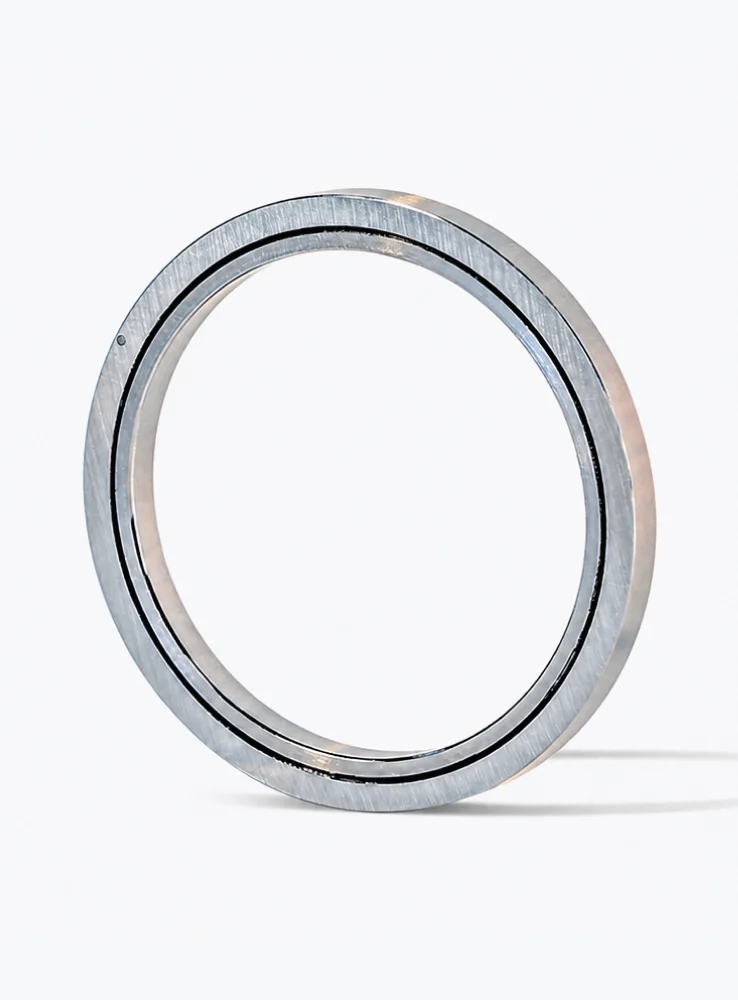
Identifying the source of play is the first step in eliminating it. Common contributing factors include:
- Manufacturing tolerances: Raceway diameter deviations and roller size variation naturally produce clearance.
- Thermal gradients: Differential expansion between shaft, alojamiento, and bearing material can open or close internal clearance.
- Wear over time: Under cyclic loading, micro-fretting and surface fatigue increase effective clearance.
- Improper preload: An incorrectly applied preload—either too low or too high—can lead to play or excess friction.
Each cause requires a distinct mitigation approach. A one-size-fits-all remedy rarely works across diverse operating environments.
Design Solutions to Eliminate Play
Eliminating play in a crossed roller bearing system demands a combination of mechanical design, manufacturing precision, and installation practice. The following approaches are proven in demanding applications.
Applying Optimized Preload
The most direct method to remove clearance is to introduce a controlled preload that forces rollers into contact with both inner and outer raceways. Preloading can be achieved by using slightly oversized rollers, tapered raceways, or by adjusting the mounting bolts. The key is to balance rigidity against friction and heat generation. Too much preload accelerates wear and increases torque; too little leaves residual play.
Using Precision-Ground Raceways
Play at the component level can be minimized by grinding raceways concurrently or by matching roller sets to measured internal clearances. Bearings supplied with ground-in preload—often marked as “tight” or “VSP” variants—provide a repeatable, near-zero clearance without relying solely on installation adjustments.
Temperature-Compensated Design
In machines that experience wide thermal swings, the bearing system must account for differential expansion. Housing materials with coefficients of expansion closer to that of bearing steel, combined with axial location flexibility, can prevent unwanted clearance from developing during warm-up phases.
Rigid Mounting Structures
Even a zero-play bearing will appear to have play if the surrounding structure deflects elastically. Flanged mountings, heavy-wall housings, and properly torqued bolts ensure that the bearing’s internal preload is not lost to structural compliance.
Benefits of Play-Free Crossed Roller Systems
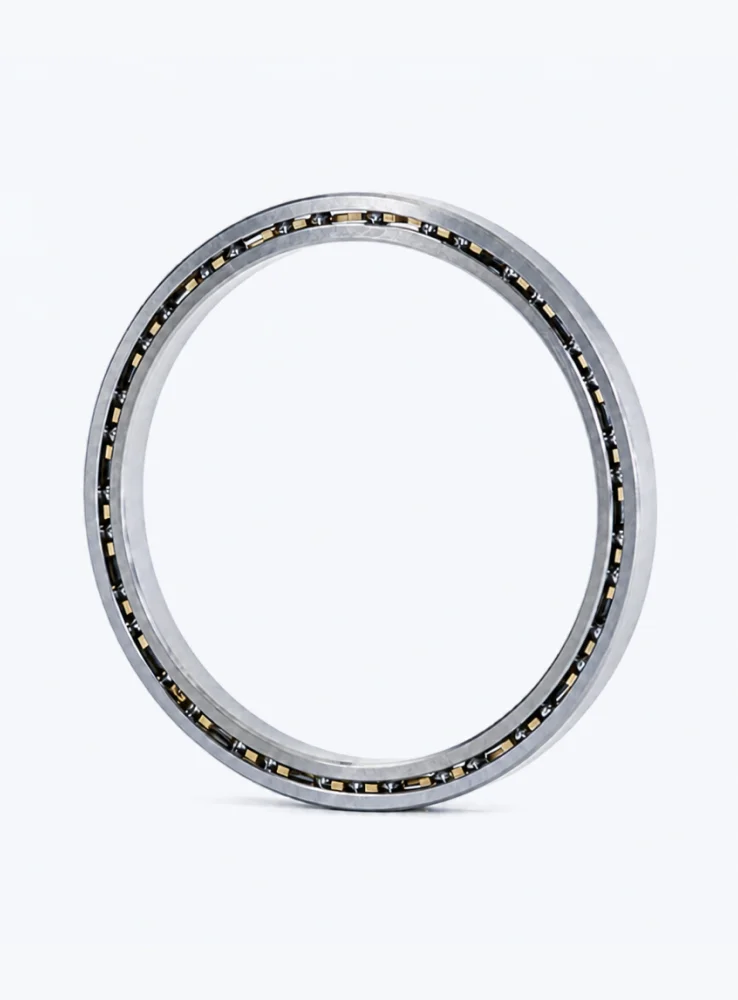
Eliminating play yields measurable advantages across the entire machine lifecycle:
- Higher positional accuracy: Without a dead zone, commanded positions are achieved immediately on reversal.
…
Click here for more details on eliminating clearance in crossed roller bearing systems: https://www.bobibearing.com/a/bearing-knowledge/eliminating-play-bearings.html

