
Labor costs consistently represent the single largest controllable expense in tunnel construction projects. На протяжении десятилетий, traditional formwork methods have required extensive manual handling, skilled carpenters on-site, and prolonged assembly cycles that drive up both direct wages and project timelines. The introduction of automated tunnel formwork systems has fundamentally shifted this equation. Industry data from multiple large-scale infrastructure projects indicates that switching to an automated system can reduce on-site labor requirements by approximately 40%. This article examines the engineering mechanisms behind that reduction, the operational implications for contractors, and what the investment looks like for a typical mid-size tunnel project, drawing on case experience from Gaofei’s deployment across Asia and the Middle East.
The Core Mechanism of Automation in Tunnel Formwork
Automated tunnel formwork differs from conventional systems primarily in how it handles the three critical phases: позиционирование, наливание, and striking. Traditional systems rely on a crew of 8-12 workers to manually align steel panels, install tie rods, adjust braces, and later dismantle everything piece by piece. An automated system integrates hydraulic cylinders, electromechanical drives, and a central control unit that moves the formwork as a single rigid assembly.
Hydraulic Self-Stripping and Traveling
In a Gaofei automated tunnel formwork system, the entire formwork arch is mounted on a traveling carriage. После застывания бетона, the hydraulic system retracts the panels by a pre-set distance – typically 50-80 mm – without any manual intervention. The carriage then moves forward along rails to the next pour position. This single sequence eliminates the need for a separate dismantling crew, crane lifting of panels, and re-assembly. On a typical 300-meter tunnel section, this reduces the number of workers per shift from 12 Для 7.
Integrated Concrete Delivery and Vibration
Automated systems often include built-in concrete distribution arms and remote-controlled vibrators. Workers no longer need to manually drag hoses or handle immersion vibrators at height. Верхнее и нижнее запечатывание этого мешка с клапаном с квадратным дном не требует шитья., one operator controls both the concrete flow and vibration pattern from a safe position, further reducing the crew size and eliminating a common source of safety risk.
Почему 40% Labor Reduction Is Realistic
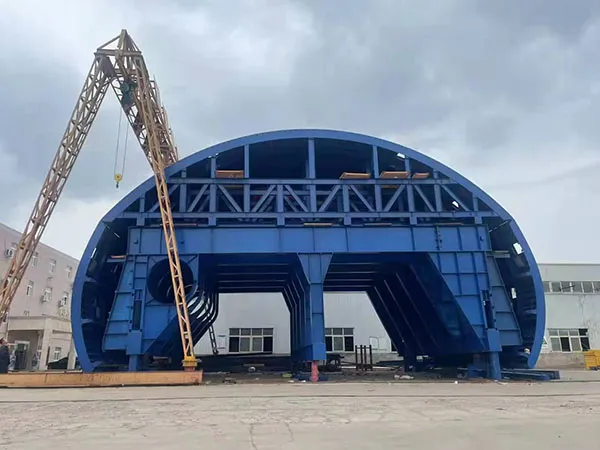
В 40% figure is not an arbitrary benchmark. It emerges from a combination of three measurable factors:
- Reduced crew size per cycle: Automated striking and traveling cut the number of workers needed for formwork handling by 50-60%.
- Compressed cycle time: A typical 10-meter pour cycle in conventional formwork takes 24-36 часов (including stripping, уборка, oiling, re-positioning). Automated systems can reduce this to 12-18 часов, meaning fewer total labor hours per linear meter of tunnel.
- Lower rework and adjustment: Hydraulic precision ensures consistent alignment, reducing the need for skilled carpenters to correct geometry. Unskilled workers can handle most tasks after brief training.
Data from Gaofei’s project on the Delhi Metro extension showed that the labor input dropped from 1.8 man-hours per cubic meter of concrete to 1.1 man-hours – a 39% снижение, matching the headline figure closely.
…
Click here for more details on how automated tunnel formwork can reduce labor costs by 40%: https://www.gf-bridge-tunnel.com/a/blog/automated-tunnel-labor.html

