
Miniature crossed roller bearings are often overlooked as simple machine elements, yet their unique design—cylindrical rollers arranged perpendicularly in a compact raceway—delivers exceptional rigidity and rotational accuracy in the smallest envelopes. While most engineers associate them with robotic joints, these components quietly power a far wider range of high-precision systems. From semiconductor fabs to orbital satellites, miniature crossed roller bearings solve motion-control challenges that conventional ball bearings simply cannot. This article explores five surprising applications where this specialized bearing type makes the critical difference, and explains why BIBO Bearing’s manufacturing expertise matters in each scenario.
1. Semiconductor Wafer Handling Robots
In semiconductor fabrication, wafers must travel through hundreds of process steps without ever touching a surface by hand. The robots that move these fragile disks rely on precision bearings in every rotating axis. While large crossed roller bearings support the main arm, miniature versions are used in the wrist axes, end-effector alignment stages, and sensor gimbals that guide the wafer into position.
The reason is rigidity under combined loads. A wafer robot accelerates and decelerates rapidly, generating tilting moments that would deform a ball bearing’s point contacts. Crossed roller bearings use line contact, which spreads the load over a much larger area. This yields five to ten times greater static stiffness in the same envelope size. For a robot that must land a 300 mm wafer on quartz pins with under 50 microns of error, bearing deflection is simply unacceptable.
Why Crossed Rollers Outperform Ball Bearings Here
- Line contact distributes load across a wider surface, eliminating localized stress points.
- High rigidity in radial, осевой, and moment directions from one compact component.
- Low and consistent friction torque, which simplifies servo tuning and increases positioning accuracy.
Vacuum-Compatible Operation
Miniature crossed roller bearings from BIBO Bearing can be supplied with porous cage materials or fully sealed grease options that comply with vacuum outgassing limits. The separable rings also simplify cleaning and re-lubrication in controlled environments. Without these properties, a bearing would become a contamination source—a fatal flaw in a cleanroom.
2. CT Scanner Gantry and Imaging Rotors
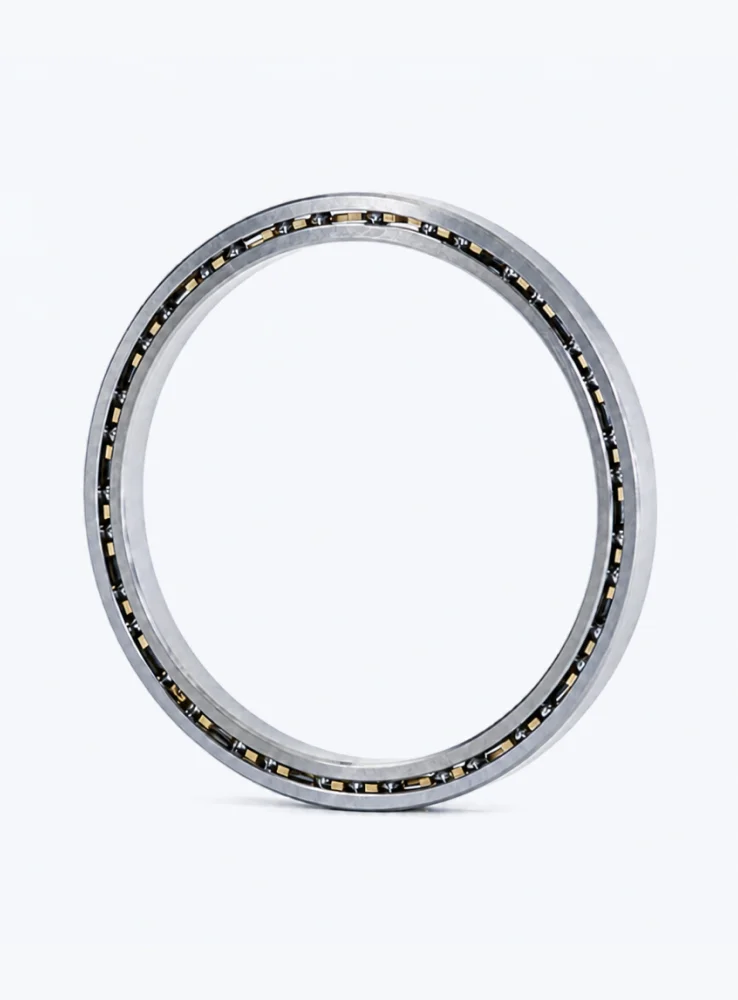
Medical imaging equipment such as CT scanners and C-arm X-ray systems must rotate a heavy emitter-and-detector assembly around a patient with sub-arcsecond consistency. The main gantry bearing is typically a large crossed roller bearing, but miniature versions appear inside the collimator, the detector positioning mechanism, and the calibration wheel.
These tiny bearings enable the fine angular adjustments that keep the radiation beam aligned with the detector array. If the bearing has excessive play, the resulting image blur can force a patient to be re-scanned—increasing radiation exposure and operational cost. С axial runout below 2 микрометры, miniature crossed roller bearings maintain the geometric integrity of the imaging chain over millions of cycles.
Quiet Operation and Long Service Life
Hospitals require equipment that runs 24/7. Crossed roller bearings distribute stress evenly, so fretting wear is drastically reduced compared to ball types. BIBO Bearing’s ground rollers and hardened raceways deliver a rated service life exceeding 10,000 hours under typical imager loads, with noise levels below 30 dB during operation.
…
Click here for more details on 5 unexpected applications of miniature crossed roller bearings: https://www.bobibearing.com/a/bearing-knowledge/miniature-crossed.html
