
Precision optical instruments—from gimbaled cameras and laser trackers to spectrometers and telescope mounts—depend on extremely accurate rotary motion. The bearings that support these systems must minimize runout, fricción, and size while maintaining repeatable positioning under varied thermal and load conditions. Thin section bearings have emerged as the preferred solution for such demanding applications, offering a unique balance of compact geometry and high precision. This article examines why these bearings are essential for precision optical instruments, how they contribute to system performance, y qué deben considerar los ingenieros al seleccionar un proveedor.
Why Thin Section Bearings Are Critical for Optical Instrument Performance
Optical instruments require precise angular alignment between optical elements, sensores, and targets. Any radial or axial displacement of a rotating component can cause beam deviation, image blur, or measurement error. Standard bearings often have large cross-sections that add unnecessary weight and envelope, which is problematic for portable or space-constrained instruments. Thin section bearings maintain a small cross-section relative to their bore diameter, allowing larger hollow shafts for cabling, optics, or scanning mechanisms without sacrificing stiffness or accuracy.
Además, thin section bearings offer design flexibility. Their reduced radial height means instrument designers can place rotary stages closer to the optical axis, minimizing Abbe errors and improving overall system accuracy. En cardanes multieje, the compact bearing envelope enables tighter package densities and reduced inertia, which directly benefits servo control bandwidth and settling time.
Key Performance Advantages of Thin Section Bearings

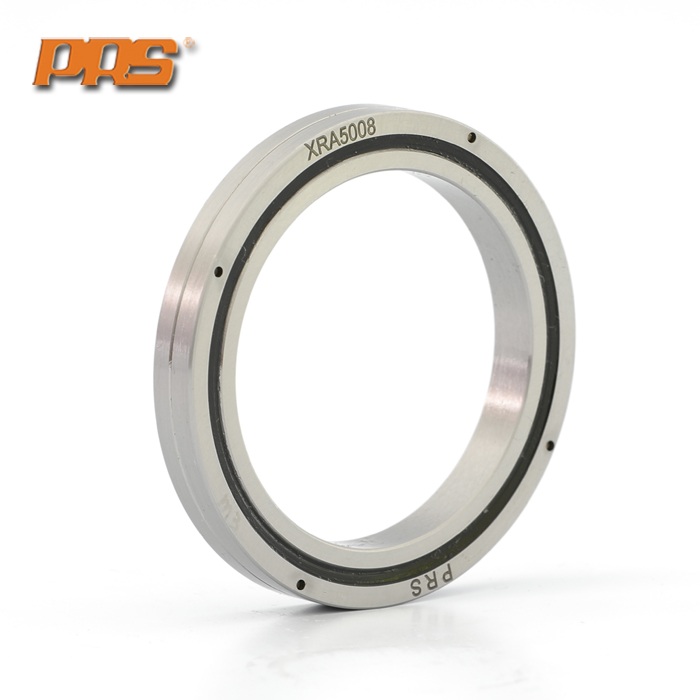
When selecting bearings for precision optical instruments, several performance characteristics become decisive. Cojinetes de sección delgada, especially those engineered by specialists like PRS, deliver measurable advantages over conventional bearing types.
- Alta precisión rotacional: Ultra-low radial and axial runout, often in the sub-micrometer range, ensures consistent optical alignment.
- Low and uniform friction torque: Liso, predictable motion is critical for fine positioning and closed-loop control.
- Sección transversal compacta: Saves space and weight, enabling miniaturization and easier integration into optical subassemblies.
- Alta relación rigidez-peso: Maintains structural rigidity without adding mass that could induce vibration or thermal drift.
- Wide operating temperature range: Stable geometry and material choices accommodate thermal expansion differences in optical housings.
- Interchangeable configurations: Available in radial, contacto angular, and four-point contact designs to suit varying axial and moment loads.
Radiales vs.. Angular Contact Thin Section Bearings
Radial thin section bearings handle primarily radial loads and offer low friction, making them suitable for simple turntables. Angular contact thin section bearings, Para el sistema de dirección que se basa en cilindros hidráulicos para empujar los neumáticos, provide higher axial and moment stiffness, which is essential for gimbals and scanners that experience overturning moments. Four-point contact versions combine high load capacity with a single bearing race, reducing component count and optimizing axial space.
…
For more detailed information on thin-section bearings for precision optical instruments, por favor haga clic aquí: https://www.prsbearings.com/news/thin-section-bearings/

