
Selecting a thin-section crossed roller bearing often comes down to one deceptively simple question: what size? The bore diameter, Наружный диаметр, and section height are not merely dimensions on a CAD drawing—they define the bearing’s load capacity, жесткость, точность вращения, and even its thermal stability. For design engineers and procurement specialists, understanding how these size-dependent parameters interact is essential to avoiding premature failure, чрезмерное отклонение, or unnecessary cost. В этом руководстве, BIBO Bearing explains why size is the critical decision driver and how to approach it systematically.
The Geometry-Performance Relationship in Thin-Section Crossed Roller Bearings
В отличие от стандартных шарикоподшипников, thin-section crossed roller bearings use cylindrical rollers arranged at right angles to each other. This compact configuration delivers high rigidity within a limited radial envelope. Однако, the bearing’s overall size directly changes the internal geometry and therefore the mechanical behavior.
Section Height: The Thin-Walled Compromise
The section height—the radial distance between the bore and the outer diameter—is the first size indicator that matters. A smaller section height reduces weight and saves space, but it also shortens the distance between the raceways. This reduction limits the roller diameter that can be fitted. Since load capacity scales with roller diameter and length, a smaller section height inevitably lowers the static and dynamic load ratings.
Переключение передач фактически меняет отношение частоты вращения двигателя к частоте вращения вала коробки передач., a larger section height allows longer and larger rollers, which distribute contact stress more effectively. For applications requiring high moment loads or frequent oscillation, choosing a bearing with a larger section height is often the most reliable way to increase service life without moving to a much larger bearing.
Roller Diameter and Contact Stress Distribution
When the bearing size increases, the roller diameter typically increases as well. Larger rollers create a greater contact area under load, reducing Hertzian contact stress. This reduction is critical in applications with heavy combined radial and axial loads. A smaller bearing may fit the design envelope, but its smaller rollers will experience higher stress at the same load, accelerating fatigue and increasing the risk of brinelling.
Например, in a 6-inch wafer handling robot, replacing a 100 mm bore bearing with a 130 mm bore bearing of the same series can increase the basic dynamic load rating by nearly 40%. That difference directly translates into longer uptime and more consistent positioning accuracy.
How Bearing Size Affects Stiffness and Rotational Accuracy
Stiffness is the bearing’s resistance to elastic deformation under load. In thin-section crossed roller bearings, the relationship between size and stiffness is not linear—it is influenced by the bearing’s raceway curvature, roller complement, and section geometry.
Moment Rigidity and Bearing Section
For rotary tables and indexing applications, moment stiffness is often the dominant requirement. A thin-section bearing with a small cross-section will deflect more under a tilting moment because the lever arm between the load point and the roller set is shorter. Increasing the radial section reduces this deflection by increasing the effective distance between the load zones. Design engineers should compare the static moment rating at different sizes before finalizing the bearing envelope.
Thermal Expansion and Internal Clearance
Size also affects how the bearing reacts to temperature changes. A larger bearing has a greater diameter, so for every degree of temperature rise, the radial expansion is proportionally larger. If the housing and shaft are made of dissimilar materials, the internal clearance can change dramatically. BIBO Bearing recommends using thermal expansion calculations early in the design phase, especially for applications with an expected operating temperature span above 20°C. Selecting a slightly larger bearing may allow for a standard clearance class, whereas a smaller bearing might require special preload or clearance adjustments.
Comparing Common Size Ranges: A Practical Decision Guide
To make the selection process more intuitive, we can group thin-section crossed roller bearings into three common size ranges. Each range offers distinct advantages and trade-offs.
- Small bore (< 100 миллиметровый): These bearings are ideal for lightweight robotics, optical instruments, и медицинское оборудование. They offer low inertia and excellent speed capability, but their load capacity is limited. Use them when space is tightly constrained and loads are relatively low.
- Medium bore (100–300 mm): The most popular range for industrial rotary tables, antenna positioning systems, and packaging machinery. This size range balances load capacity, жесткость, и стоимость. Large enough to handle modest moment loads, yet compact enough to fit within standard machine frames.
- Large bore (> 300 миллиметровый): Used in heavy-duty turntables, wind turbine blade alignment systems, and large-format rotary indexers. These bearings provide the highest moment stiffness and load capacity. Однако, they require careful mounting design to prevent housing distortion and ensure even load distribution.
It is important to note that a larger bore does not automatically mean a larger section height. Thin-section bearings are defined by their cross-sectional profile, and there are standardized series (например, inch and metric thin series) that maintain the same section height across multiple bore sizes. This feature allows designers to increase the bore diameter—and thus the moment arm—without increasing the bearing’s radial footprint.
Application-Driven Sizing: Where Thin-Section Crossed Roller Bearings Excel
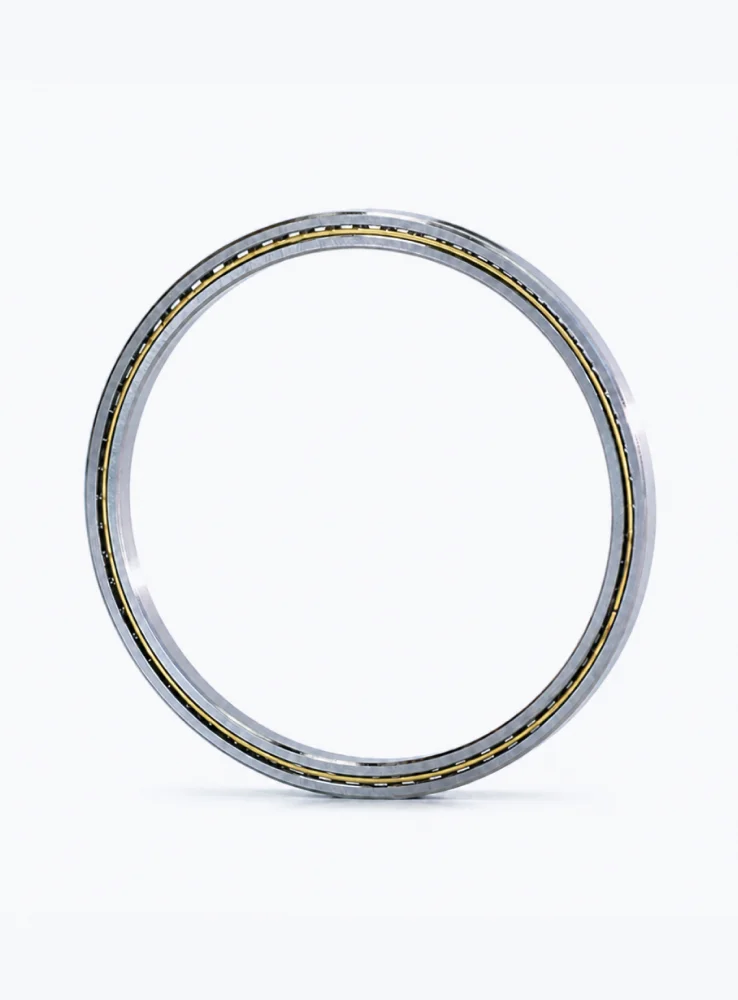
Robotics and Rotary Tables
В роботизированных суставах, the bearing size is constrained by the overall joint diameter and the required hollow shaft for cabling. A thin-section crossed roller bearing with a larger bore can provide a wider pass-through hole while still supporting the cantilevered load. The size directly affects the robot’s reach accuracy and payload capability. Skipping from a 150 mm bore to a 200 мм диаметр отверстия, например, can reduce end-effector deflection by 35% in some articulated arm configurations.
…
Click here for more detailed information on thin-section crossed roller bearings and why dimensions matter: https://www.bobibearing.com/a/bearing-knowledge/size-matters.html

