
The clearance of a slewing bearing directly determines the operational stability, distribución de carga, and service life of an excavator. An improper clearance can lead to excessive vibration, desgaste acelerado, or even catastrophic failure of the superstructure. For maintenance teams, equipment dealers, and fleet managers, understanding what constitutes the ideal clearance is not merely technical—it is a financial decision affecting downtime and repair costs. This article explores the definition, influencing factors, industry-recommended values, and how to verify the correct clearance for your excavator. We also highlight how LYMC applies precision engineering to deliver bearings that meet or exceed OEM specifications.
What Is Slewing Bearing Clearance?
Slewing bearing clearance, often referred to as axial or radial play, is the measured gap between the rolling elements and the raceways under a defined load condition. For excavators, the clearance is critical because the bearing must handle combined axial, radial, and tilting moment loads during digging, swinging, and lifting operations.
Types of Clearance
- Initial clearance – the clearance before installation, as manufactured. This is what bearing suppliers specify on datasheets.
- Mounting clearance – the clearance after the bearing is installed in the excavator, affected by housing fit and bolt preload.
- Operating clearance – the clearance under actual working loads and temperature conditions. Thermal expansion and elastic deformation change the clearance.
For excavator slewing bearings, the most commonly referenced parameter is the axial internal clearance measured under a standard preload (typically 500–1000 N). The ideal value is a balance: enough clearance to prevent jamming from thermal expansion, but not so much that it causes slop and uneven load distribution.
Factors That Determine the Ideal Clearance
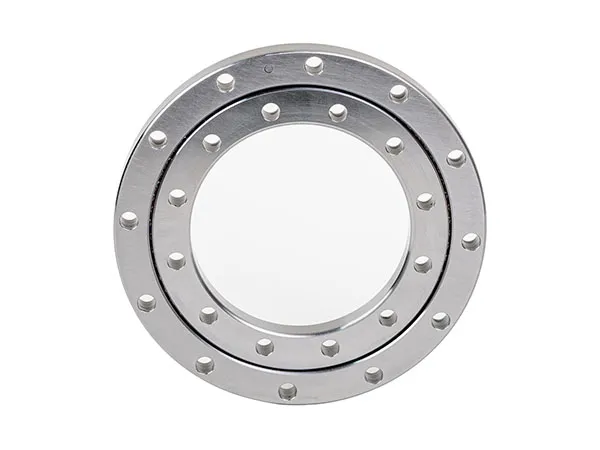
Selecting the correct clearance requires evaluating several operating conditions. No single value fits all excavators.
Load Magnitude and Direction
Excavators experience high tilting moments during digging. A bearing that is too loose will allow excessive tilting, accelerating raceway and ball wear. Si el tractor puede cambiar de marcha en el momento oportuno, a bearing that is too tight may induce high internal stress, reducing fatigue life. For standard excavators (20–50 ton class), axial clearance typically falls between 0.04 mm y 0.12 mm (40–120 microns) for single-row ball slewing rings, y 0.08–0.20 mm for cross-roller types.
Operating Speed and Temperature
Excavator slewing speeds are low (usually 1–5 rpm), so heat generation is modest. Sin embargo, in hot climates or continuous heavy digging, the bearing temperature can rise 15–30°C above ambient. Thermal expansion of the raceways reduces clearance. Engineers often specify an initial clearance at the upper end of the tolerance band when the excavator will work in high-temperature environments.
…
To learn more about the ideal clearance for excavator slewing bearings, please click here for detailed information: https://www.mcslewingbearings.com/a/news/bearing-clearance-guide.html

