
In precision machinery, the choice of slewing bearing directly determines positioning accuracy, repeatability, and long-term stability. Cross-roller slewing bearings have emerged as the preferred solution for demanding applications such as semiconductor manufacturing, medical imaging, and precision rotary tables. Their unique roller arrangement provides superior moment stiffness and rotational accuracy compared to conventional ball-type bearings. This article examines the engineering principles behind their performance, compares them with alternative designs, and explains why cross-roller bearings—especially those manufactured by LYMC—are the optimal choice when sub-arcminute accuracy is required.
The Structural Advantage of Cross-Roller Slewing Bearings
Unlike single-row ball slewing rings, cross-roller bearings arrange cylindrical rollers in a crisscross pattern at a 90° angle between two adjacent rollers. This configuration provides equal load capacity in all radial, axial, and moment directions. Each roller is separated by a spacer, eliminating friction between adjacent rollers and reducing heat generation. The line contact between rollers and raceways distributes stress over a larger area, resulting in significantly higher static and dynamic load ratings compared to ball contacts of equivalent size.
Preload and Rigidity
Cross-roller bearings are typically supplied with a negative internal clearance (preload) tailored to the application. This preload removes all axial and radial play, ensuring that the bearing behaves like a solid ring under load. The result is high system stiffness, which is critical for maintaining positional accuracy under varying cutting forces or torque loads. In contrast, ball-type slewing rings often require external preloading devices or serrated locking mechanisms to achieve similar rigidity.
Comparison: Cross-Roller vs. Other Slewing Bearing Types
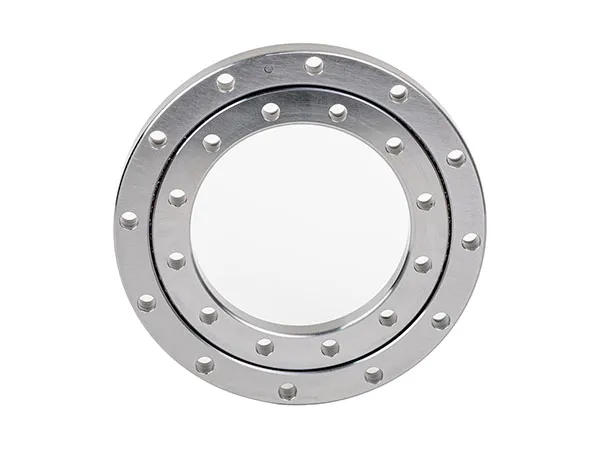
To understand why cross-roller bearings excel, it is useful to compare them directly against common alternatives used in high-precision tasks.
- Single-row 4-point contact ball bearings: These bearings rely on point contact, which limits moment stiffness. Under combined loads, ball deformation increases friction and reduces rotational accuracy. Cross-roller bearings offer 3–5× higher moment rigidity in a comparable envelope.
- Double-row ball slewing rings: While they improve load capacity over single-row designs, the balls still produce point contact. The axial preload needed to eliminate play increases wear and limits service life. Cross-roller bearings maintain consistent torque over thousands of cycles with minimal wear.
- Wire-race bearings: These are lighter but less rigid. Their steel wires deform under high dynamic loads, making them unsuitable for sub-micron repeatability. Cross-roller bearings, manufactured from hardened bearing steel (e.g., SUJ2 or 50CrMo4), provide dimensional stability over temperature variations.
Key Performance Parameters in High-Precision Tasks
When evaluating a slewing bearing for tasks such as wafer handling, laser cutting, or optical alignment, engineers focus on four metrics:
- Running accuracy (TIR): Cross-roller bearings achieve axial runout values below 5 µm when installed correctly. This is due to the precision-ground raceways and matched roller sets.
- Friction moment uniformity: The roller-cage assembly ensures low and consistent starting torque, essential for servo-driven rotary axes that require smooth motion at low speeds.
- Life under continuous oscillation: Many high-precision applications involve partial rotation (e.g., ±90°). Cross-roller bearings excel here because the line contact distributes wear evenly across the raceway surface, preventing brinelling common with ball bearings.
- Thermal stability: Because cross-roller bearings generate less heat than sliding bearings or heavily preloaded ball bearings, they maintain their geometry over long operating periods. LYMC uses advanced heat treatment processes to achieve Rockwell hardness of HRC 58–62 on raceways, ensuring consistent performance even in temperature-controlled cleanrooms.
…
For more details on why crossed-roller slewing bearings excel in high-precision applications, please click here: https://www.mcslewingbearings.com/a/news/cross-roller-precision.html

