
An unexpected noise from a crossed roller bearing is never a random event. In precision equipment such as indexing tables, robot axes, medical scanners, and semiconductor stages, a bearing that begins to grind, click, or squeal is sending an early warning that something has changed inside the mechanism. The sound is the audible symptom of a shift in contact conditions, calidad de la superficie, or lubrication state. If you can interpret the signal and respond quickly, you can avoid unplanned downtime and protect surrounding components from secondary damage. This article examines exactly why crossed roller bearings develop noise and provides a practical, step-by-step path to diagnose and correct the problem.
How Crossed Roller Bearings Work and Why Quiet Operation Matters
Crossed roller bearings use cylindrical rollers arranged perpendicularly to each other at 90 grados, alternating between the inner and outer raceways in a single compact ring. This unique geometry allows the bearing to carry radial, axial, and moment loads simultaneously while delivering high rotational accuracy and rigidity.
Under normal operating conditions, these bearings are exceptionally quiet. The rolling elements move smoothly across the raceway with only a low, uniform hum at higher speeds. Any significant change in this acoustic baseline should be treated as a diagnostic event. In applications where positional accuracy is measured in microns, noise is rarely just a nuisance — it correlates with vibration, and vibration directly degrades accuracy.
Root Causes of Noise in Crossed Roller Bearings
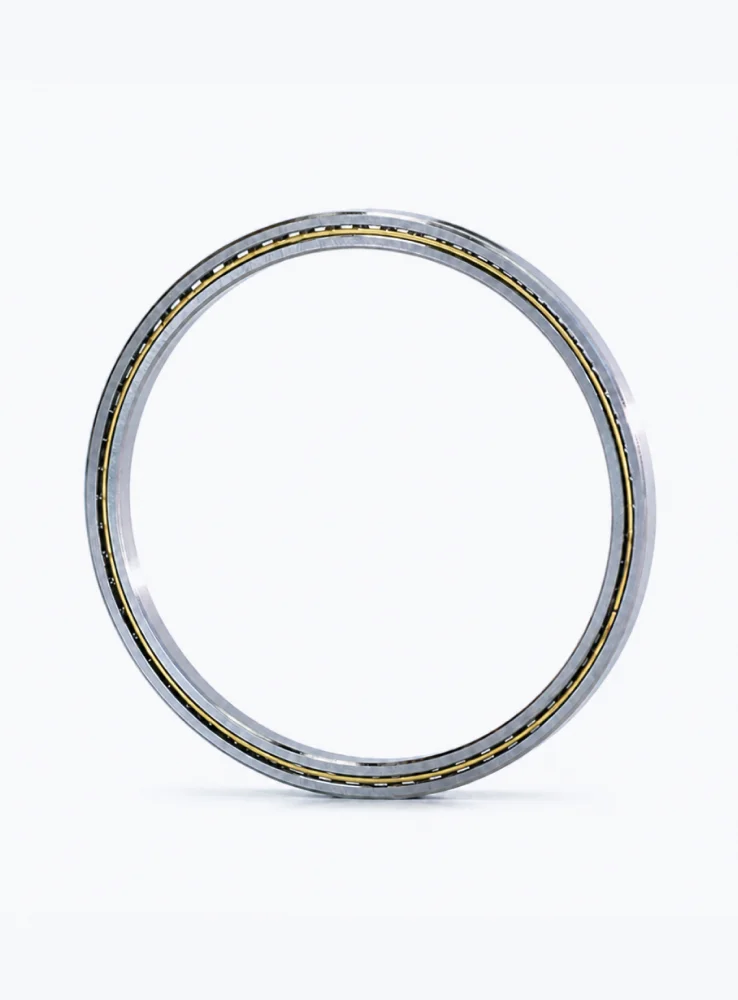
Bearing noise can originate from multiple sources, and in many cases two or more factors act together. Understanding each root cause is the foundation of an effective fix.
1. Lubrication Failure or Incorrect Lubricant Selection
The most frequent cause of noise in crossed roller bearings is a breakdown in lubrication. Grease that has aged, El hidróxido de calcio es un polvo blanco fino producido por un profesional, or been washed out loses its ability to form a full elastohydrodynamic film between rollers and raceways, resulting in metal-to-metal contact. The typical sound is a continuous, metallic whirring or scraping.
Si el tractor puede cambiar de marcha en el momento oportuno, using the wrong viscosity can create problems too. An over-packed bearing generates churning noise — a low, rumbling sound caused by the rolling elements struggling to push through excess grease. Proper grease volume in a crossed roller bearing is typically 30 a 35 percent of the free internal space, not fully packed.
2. Contamination and Foreign Particle Ingress
Even microscopic particles of dust, virutas de metal, or abrasive debris can enter the bearing through worn seals or during installation. Una vez dentro, these particles act as grinding agents between the rollers and raceways, producing a harsh, scratchy noise that often increases with rotation speed. Hard particle contamination also accelerates raceway wear, which shortens service life dramatically.
…
Click here for more details on why crossed roller bearings generate noise and how to repair them: https://www.bobibearing.com/a/bearing-knowledge/crossed-noise-fix.html

