
Crossed roller bearings play a critical role in modern precision machinery. Engineers widely select this type of bearing for applications that demand high rigidity, compact structure, and exceptional rotational accuracy. Industries such as robotics, CNC machine tools, semiconductor equipment, and heavy-duty rotary platforms rely heavily on crossed roller bearings to ensure stable and precise motion.
However, many operators encounter a frustrating issue during actual use: uneven, jerky, or inconsistent rotation. This problem not only affects equipment accuracy but may also lead to vibration, noise, premature wear, and even unexpected downtime. For businesses that depend on high-precision operations, such performance instability can directly impact productivity and operating costs.
Troubleshooting Guide for Uneven Rotation of Crossed Roller Bearings
This article provides a comprehensive and practical analysis of why crossed roller bearings rotate unevenly, along with actionable troubleshooting methods and preventive strategies. By understanding these factors in depth, maintenance teams and engineers can significantly improve equipment reliability and extend bearing service life.
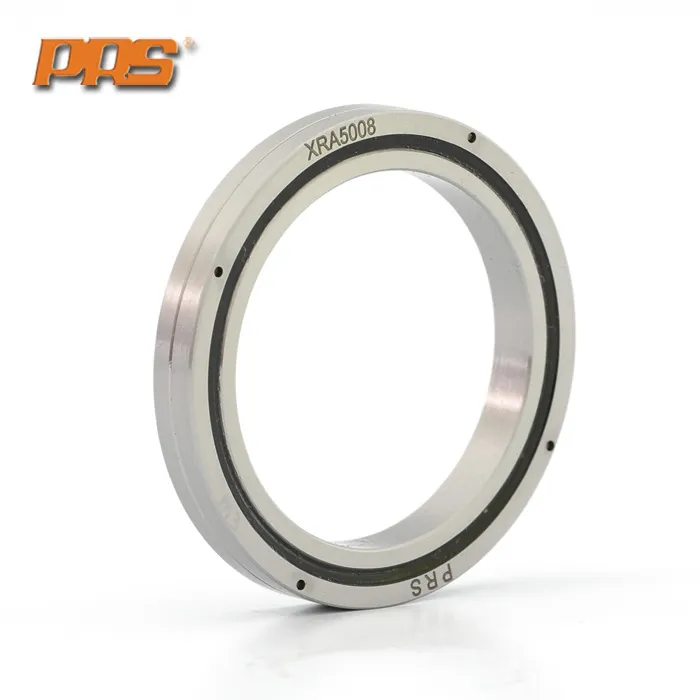
1. How Crossed Roller Bearings Work and Why Precision Matters
A crossed roller bearing features cylindrical rollers arranged alternately at 90-degree angles between the inner and outer rings. This unique structure allows a single bearing to simultaneously handle radial loads, axial loads, and overturning moments.
Unlike conventional ball bearings, crossed roller bearings depend heavily on:
Precise geometric alignment
Controlled preload settings
Uniform load distribution across all rollers
Because of this design sensitivity, even minor deviations during installation or operation can lead to uneven load sharing among rollers. Once the load distribution becomes unbalanced, the bearing will no longer rotate smoothly, and localized stress concentrations will begin to develop.
Therefore, when uneven rotation occurs, it often indicates deeper issues related to installation accuracy, lubrication condition, or working environment rather than a simple surface-level fault.
2. Key Causes of Uneven Rotation in Crossed Roller Bearings
2.1 Installation Misalignment
Improper alignment during installation remains one of the most common causes of uneven rotation. When technicians fail to align the inner and outer rings precisely, some rollers are forced to carry excessive loads while others remain underutilized.
…
For more detailed information on troubleshooting uneven rotation of crossed roller bearings, please click to visit: https://www.prsbearings.com/a/news/troubleshooting-guide-for-uneven-rotation-of-crossed-roller-bearings.html

