
Slewing bearings are critical components in heavy machinery such as cranes, excavators, wind turbines, and material handling equipment, enabling smooth rotational movement under extreme loads. Despite their robust design, these bearings are susceptible to a range of failures that can lead to costly downtime, unsafe operating conditions, and premature replacement. Understanding the root causes of these failures—and implementing targeted prevention strategies—is essential for maximizing equipment reliability and total cost of ownership. This article examines the most common slewing bearing failure modes experienced across industries and provides actionable prevention guidance, with insights from LYMC, a leading manufacturer known for precision-engineered slewing bearings.
1. Material Spalling and Flaking
Spalling, also referred to as flaking or pitting, is the gradual removal of metal from the raceway surfaces or rolling elements. It is the most frequently reported failure mode in slewing bearings, often resulting in vibration, noise, and eventual seizure.
Root Causes
- Overloading: Excessive static or dynamic loads beyond the bearing’s rated capacity cause subsurface fatigue, initiating cracks that propagate to the surface.
- Inadequate lubrication: Insufficient or degraded grease fails to form a protective elastohydrodynamic film, leading to metal-to-metal contact and accelerated wear.
- Contamination: Hard particles such as sand, dust, or metal debris enter the bearing raceways, acting as abrasives that induce micro-cracking.
- Misalignment: Angular misalignment between the bearing rings concentrates stress on localized areas, promoting early spalling.
Prevention Measures
- Strictly adhere to the manufacturer’s load ratings and avoid shock loads during operation.
- Implement a scheduled relubrication program using high-quality grease appropriate for the operating environment (temperature, moisture, speed).
- Use proper sealing solutions such as labyrinth seals or elastomeric lip seals to keep contaminants out. LYMC bearings feature advanced multi-lip seal designs that provide superior ingress protection.
- Verify alignment during installation with a dial indicator or laser alignment tool; shim as needed to achieve parallelism within 0.1 mm per meter.
2. Cracked Rings or Fractured Raceways
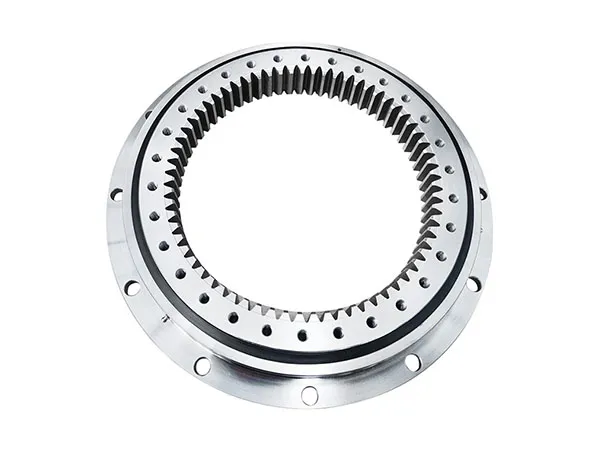
Cracking—whether in the inner ring, outer ring, or rolling elements—is a catastrophic failure that often results in immediate equipment stoppage and potential safety hazards.
Root Causes
- Brinelling: High static impact loads (e.g., during transport or improper lifting) create indentations that act as stress raisers, leading to ring fracture.
- Thermal stress: Rapid temperature changes or uneven heating (e.g., from welding nearby) can cause differential expansion and cracking.
- Hydrogen embrittlement: In corrosive environments, hydrogen atoms diffuse into the steel, reducing toughness and causing sudden fracture.
- Material defects: Inclusions, porosity, or improper heat treatment in inferior bearings create weak points.
…
For more detailed information on common slewing bearing failures and their prevention, please click here: https://www.mcslewingbearings.com/a/news/slewing-bearing-failures.html

