
Choosing thin section bearings requires careful consideration of your application’s specific needs. These bearings are prized for their space-saving and weight-reducing characteristics, but their “thinness” also makes them more sensitive to certain factors.
How to Choose Thin Section Bearings
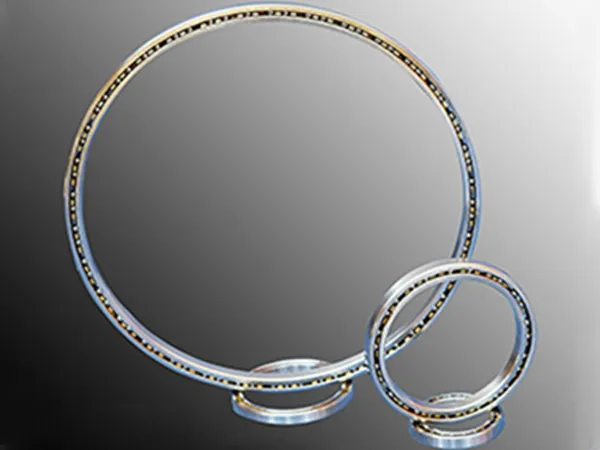
Understand Your Application’s Requirements:
This is the most crucial step. Define:
Loads:
Radial Load: Perpendicular to the shaft axis.
Axial (Thrust) Load: Parallel to the shaft axis.
Moment Load: A load that tends to cause rotation about an axis (tilting). Thin section bearings can handle moment loads, but the type and configuration are critical.
Magnitude and Direction: Quantify these loads. Are they static or dynamic?
Speed (RPM): Operating speed and any peak speeds. This affects lubrication and heat generation.
Space Envelope: What are the maximum allowable outer diameter (OD), inner diameter (ID), and width? This is often the primary driver for choosing thin section bearings.
Accuracy & Rigidity:
Runout: How much deviation from perfect rotation is acceptable?
Stiffness/Rigidity: How much will the bearing deflect under load? This is critical for precision applications.
Operating Environment:
Temperature: Operating range, extremes.
Contamination: Presence of dust, dirt, moisture, chemicals. This dictates sealing requirements.
Corrosion: Will the bearing be exposed to corrosive substances?
Life Expectancy: How many hours or revolutions does the bearing need to last? (L10 life)
Maintenance Requirements: Is relubrication possible or desired?
Select the Bearing Type (Based on Load):
Thin section bearings come in three main contact types:
Type C (Radial Contact / Conrad):
Best for: Primarily radial loads. Can handle light to moderate thrust loads in one direction.

Characteristics: Deep groove, suitable for higher speeds.
Type A (Angular Contact):
Best for: Combined radial and thrust loads (thrust in one direction). Often used in pairs (duplexed) to handle thrust in both directions and increase moment capacity/stiffness.
Characteristics: Has a specific contact angle. Higher contact angles provide greater axial load capacity but lower radial capacity and speed capability.
…
More details about how to choose thin section bearings can be found by clicking visit: https://www.lynicebearings.com/a/blog/how-to-choose-thin-section-bearings.html
