
In precision machinery and robotics, the ability to withstand heavy loads while maintaining rigidity is often the deciding factor between success and failure. Crossed roller bearings have emerged as a superior solution for applications demanding both high load capacity and exceptional stiffness. Unlike conventional ball bearings that rely on point contact, crossed roller bearings utilize cylindrical rollers arranged in a unique cross-pattern between inner and outer rings. This design fundamentally changes how forces are distributed, allowing the bearing to handle radial, axial, and moment loads simultaneously with minimal deflection. For engineers seeking reliability in demanding environments such as machine tools, medical imaging equipment, and industrial robots, understanding the technical advantages of crossed roller bearings is essential. This article examines the structural principles and performance benefits that make them the preferred choice for applications where precision and durability are non-negotiable.
Structural Design Principles Behind Superior Load Capacity
The core of a crossed roller bearing lies in its roller arrangement. Cylindrical rollers are positioned at 90-degree angles to each other, separated by a retainer that maintains precise spacing. This cross-pattern allows each roller pair to share loads from multiple directions simultaneously. Because the rollers make line contact with the raceway surfaces rather than point contact, the contact area is significantly larger than in ball bearings. For a given load, this reduces stress concentration, enabling the bearing to support up to several times the load of an equivalently sized ball bearing. Additionally, the alternating orientation of rollers ensures that radial, axial, and tilting moments are all absorbed by the same roller set, eliminating the need for separate bearing rows in many applications.
Roller Geometry and Material Optimization
PRS manufactures crossed roller bearings using bearing-grade steel with precise roller crowning to avoid edge stress. The rollers are typically through-hardened to achieve optimal hardness and wear resistance. The combination of line contact and controlled roller geometry means that load capacity scales nearly linearly with roller diameter and length, a critical advantage when space constraints demand compact yet robust solutions.
Stiffness Advantages Over Traditional Bearing Types
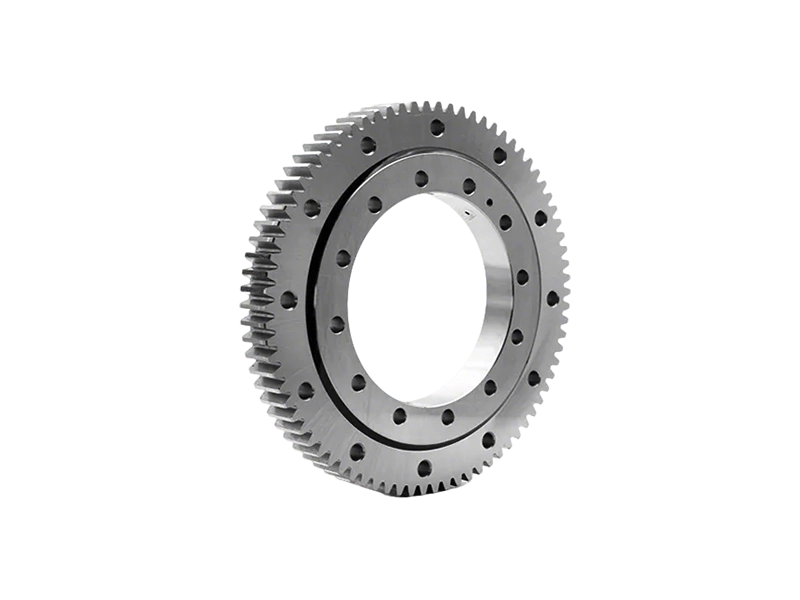
Stiffness—the ability to resist deformation under load—is even more critical than load capacity in many precision applications. Crossed roller bearings exhibit significantly higher stiffness compared to ball bearings and even some cylindrical roller bearings. The line contact interface creates a larger elastic deformation zone, which paradoxically reduces total deflection because the load is distributed over a broader area. Furthermore, the preload capability of crossed roller bearings is exceptional. By adjusting the radial clearance during manufacturing, engineers can achieve near-zero or even negative clearance, resulting in a bearing that exhibits virtually no measurable deflection under moderate loads.
Comparative Stiffness Breakdown
- Ball bearings: Point contact leads to high initial deflection; stiffness is low and nonlinear, especially under moment loads.
- Cylindrical roller bearings: Line contact provides good radial stiffness but poor axial and moment stiffness because rollers are oriented in one direction only.
…
For more detailed information on load capacity and stiffness: the advantages of crossed roller bearings, please click to visit: https://www.prsbearings.com/a/news/crossed-roller-advantages.html
