
When selecting the right bearing for your rotating machinery, the choice often comes down to a slewing bearing versus a traditional bearing. Both serve the fundamental purpose of enabling rotational motion while supporting loads, yet their design philosophies, application scopes, and performance characteristics differ significantly. Understanding these differences is critical for engineers and procurement professionals who need to optimize equipment reliability, cost efficiency, and operational longevity. This article provides a rigorous, side-by-side comparison to help you determine which bearing type best suits your specific requirements. We will also highlight insights from LYMC, a manufacturer with extensive experience in both domains.
1. Fundamental Design and Structure Differences
The most apparent distinction between slewing bearings and traditional bearings lies in their physical architecture and how they handle forces. Traditional bearings—such as ball, roller, or tapered roller bearings—are typically compact, standardized components designed for high-speed rotation with moderate radial and axial loads. In contrast, slewing bearings (also known as slewing rings) are large-diameter, integrated assemblies that can simultaneously sustain heavy axial loads, radial loads, and tilting moments.
Load Capacity and Direction
Slewing bearings excel in applications where the load is not purely radial or axial but involves combined forces and overturning moments. Their design often incorporates multiple raceways with rows of balls or rollers (e.g., four-point contact ball or crossed roller) to capture forces from multiple directions. Traditional bearings, on the other hand, are optimized for uni‑directional or bi‑directional loading (e.g., deep‑groove ball bearings for radial loads, thrust bearings for axial loads). When tilting moments are present, traditional bearings may require complex mounting arrangements or multiple bearings in a back‑to‑back configuration, increasing system complexity.
Installation Complexity
Traditional bearings are generally off‑the‑shelf components that can be mounted using standard shaft and housing fits. Installation is relatively straightforward, often requiring only press‑fitting or heat‑fit methods. Slewing bearings, however, are bolted directly to adjacent structures (e.g., a turntable and a base) using a ring of mounting holes. This demands precise alignment and torque control, but it eliminates the need for additional housings or shafts. LYMC’s application engineers note that while slewing bearing installation is more involved, it simplifies the overall system design in heavy‑duty rotary applications such as cranes, excavators, and wind turbines.
2. Performance and Application Comparison
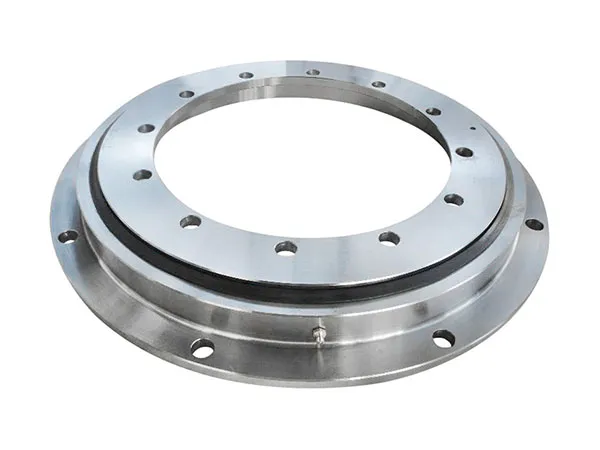
The following list summarizes key performance criteria where slewing bearings and traditional bearings diverge:
- Speed capability: Traditional bearings operate at high RPM (thousands of revolutions per minute). Slewing bearings are designed for slow to moderate rotation (typically under 100 RPM).
…
For more detailed information on the main differences between slewing bearings and traditional bearings, please click to visit:https://www.mcslewingbearings.com/a/news/slewing-bearing-vs-traditional-bearing.html

