
When choosing between industrial steel structures and concrete for your next facility, the question of longevity often tops the list. Both materials have proven track records, but they behave very differently under stress, weather, and time. This article provides an evidence-based comparison of steel structure vs concrete durability, helping you make a confident investment decision. We will examine structural integrity, maintenance requirements, environmental resilience, and real-world performance—all while highlighting how MeiChen Steel delivers structures engineered for maximum lifespan.
Material Durability Under Mechanical Stress
Steel: High Strength-to-Weight Ratio
Industrial steel structures benefit from a strength-to-weight ratio up to six times higher than reinforced concrete. This means steel can span longer distances with fewer supports, reducing weak points. Under uniform loads, steel maintains elastic behavior for decades, provided it is properly coated. MeiChen Steel uses advanced galvanization and painting systems that resist corrosion, ensuring the frame remains structurally sound for 50+ years in typical industrial environments.
Concrete: Compression Performance
Concrete excels in compression but is weak in tension. Over time, repeated load cycles cause micro-cracking, especially in industrial floors or columns subject to heavy machinery vibration. While concrete can last 30–50 years in benign conditions, it often requires crack injection or resurfacing after 20 years in aggressive industrial settings. The embedded rebar is also vulnerable to corrosion once chlorides penetrate the surface.
Key takeaway: Steel structures are less prone to progressive failure and can be designed to outlast concrete in dynamic industrial applications.
Environmental Resistance and Maintenance
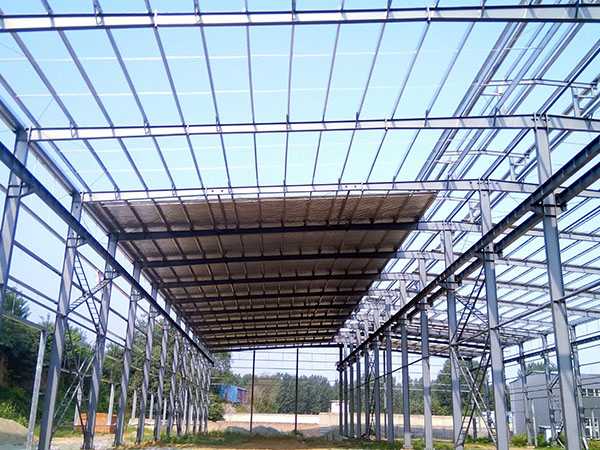
Corrosion and Chemical Exposure
Industrial facilities often expose building materials to chemicals, moisture, and extreme temperatures. Concrete can suffer from sulfate attack, alkali-aggregate reaction, and freeze-thaw spalling. Steel, when properly protected, resists these chemical attacks. MeiChen Steel applies hot-dip galvanizing and epoxy coatings that meet ISO 12944 standards, providing at least 25 years to first maintenance in C4 corrosivity environments. Concrete requires periodic sealing and repairs which can be costly and disruptive.
Fire Resistance
Concrete is naturally fire-resistant, while steel loses strength above 540°C (1000°F). However, modern intumescent coatings and fireproofing boards can protect steel for up to 3 hours. MeiChen Steel integrates fire-resistive design into every project, balancing safety with longevity. For industrial buildings with sprinklers, steel often meets fire codes without sacrificing durability.
Factors That Determine Lifespan in Industrial Buildings
- Design quality: Proper load calculations and detailing prevent early degradation. MeiChen Steel uses finite element analysis to optimize connections and reduce stress concentrations.
- Construction precision: Bolted steel connections are easier to inspect and maintain than cast-in-place concrete joints, where hidden voids can propagate cracks.
- Environmental exposure: In coastal or corrosive environments, steel with adequate coating often outperforms concrete, which can lose rebar bond strength within 15 years without proper cover.
- Lifecycle cost: While initial steel structure cost may be higher, lower maintenance and faster erection lead to better long-term value.
…
For more detailed information on industrial steel structures versus concrete structures—and which is more durable—please click here: https://www.meichensteel.com/a/procurement-guides/steel-vs-concrete.html

