
In modern manufacturing and fabrication industries, the welding of irregular workpieces has long posed significant challenges. Traditional welding methods often struggle to accommodate asymmetrical or unusually shaped components, leading to uneven welds, increased labor, and longer production times. This is where customizable welding rotators for irregular workpieces play a transformative role, enabling manufacturers to achieve higher precision, efficiency, and consistency in their welding operations.
Understanding the Challenges of Irregular Workpiece Welding
Irregular workpieces, such as large-diameter pipes, conical structures, or components with non-standard geometries, often require complex positioning during welding. Manual rotation or handling can result in misalignment, inconsistent weld penetration, and safety risks for operators. Furthermore, conventional rotators with fixed configurations are frequently unable to adapt to non-cylindrical shapes, forcing production teams to rely on makeshift solutions that compromise both quality and workflow.
Manufacturers face several pain points when working with irregular workpieces, including:
Uneven Welding Quality: Irregular shapes make it difficult to maintain a consistent welding speed and angle, leading to defects such as undercut, incomplete fusion, or excessive weld bead buildup.
Increased Labor Costs: Manual adjustment and repositioning of heavy components consume significant manpower and increase production costs.
Safety Hazards: Handling large, awkwardly shaped workpieces manually increases the risk of workplace injuries and accidents.
Production Delays: Frequent repositioning and adjustments can slow down the workflow, reducing overall efficiency and throughput.
Addressing these challenges requires a solution that combines adaptability, precision, and automation.
How Customizable Welding Rotators Provide a Solution
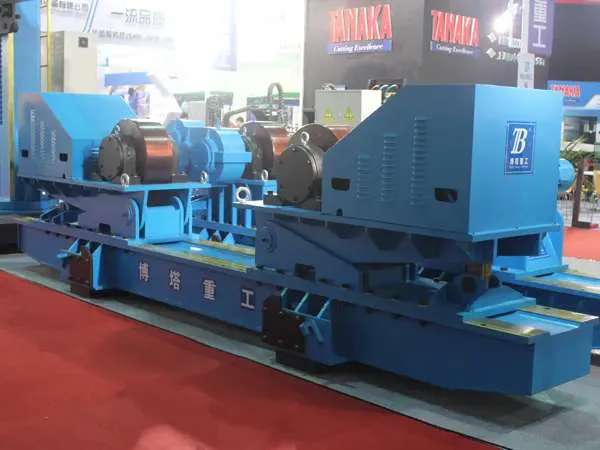
Customizable welding rotators for irregular workpieces are engineered specifically to accommodate a wide range of shapes and sizes. Unlike standard welding rotators, these units allow operators to adjust roller positions, load capacities, and rotational speeds according to the specific geometry of the workpiece. Key benefits include:
Versatile Roller Configurations: These rotators can be customized with multiple roller setups—V-shaped, U-shaped, or adjustable flat rollers—that securely cradle cylindrical, conical, or irregular components.
Precise Rotation Control: Advanced motorized systems provide smooth and stable rotation, enabling consistent welds across the entire workpiece. Variable speed control allows operators to optimize welding speed for different materials, thicknesses, and joint types.
Enhanced Safety: By minimizing manual handling, these rotators reduce the risk of operator injuries, ensuring a safer working environment.
Improved Productivity: Automation of rotational movement streamlines workflow, reduces downtime, and allows welding teams to focus on quality rather than constant repositioning.
For fabrication facilities that handle custom or one-off projects, the flexibility of customizable rotators ensures that even highly irregular components can be welded efficiently without the need for temporary fixtures or elaborate handling solutions.
…
For more detailed information on the enhancing welding efficiency with customizable welding rotators for irregular workpieces, please click to visit:https://www.bota-weld.com/en/a/news/customizable-welding-rotators-for-irregular-workpieces.html

