
Crossed roller bearings are built for the tight spaces and heavy demands of precision rotary tables, robot joints, indexing heads, and gear reducers. Their rollers are arranged at 90 degrees to one another in a single wide raceway, and that design concentrates load, reduces deflection, and leaves very little internal clearance for lubricant to circulate. As a result, the lubrication decision carries more weight than in an ordinary ball bearing. The wrong grease, an incorrect fill volume, or a missed relubrication interval will show up as rising torque, elevated running temperature, and eventual raceway spalling. This guide covers lubricant function, grease versus oil selection, quantity, relubrication intervals, and the application errors that shorten bearing life.
What Lubrication Actually Does Inside a Crossed Roller Bearing
Lubricant is not simply there to make things slippery. In a crossed roller bearing, it performs several jobs at once, and each one matters for accuracy as much as for life.
- Film separation: A hydrodynamic or elastohydrodynamic film keeps roller surfaces and raceways apart under load, preventing metal-to-metal contact that leads to micropitting and wear.
- Friction and torque control: Consistent film thickness keeps starting and running torque predictable, which is critical in servo-driven positioning axes.
- Heat transfer: Lubricant carries frictional heat away from the contact zones. Crossed roller bearings typically have limited space for this, so circulation matters.
- Corrosion protection: Moisture and acidic residues attack polished raceways quickly. Additives in the lubricant form a protective layer.
- Contamination exclusion: A well-packed grease cavity helps block fine particles and cutting fluid from entering the raceway.
Because the rollers cross and the cage pockets are narrow, lubricant distribution is rarely uniform. That makes both the type and the quantity of lubricant more sensitive than in simpler bearing designs.
Grease or Oil: Matching the Lubricant to the Application
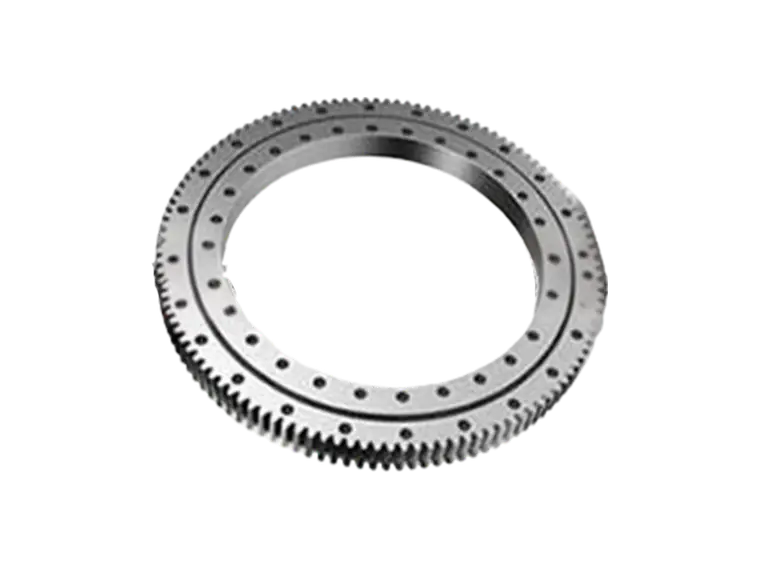
Most cross roller bearing installations end up on grease, but oil remains the correct choice in specific cases. The decision should follow speed, thermal load, sealing, and maintenance access.
When grease is the right choice
Grease stays in place, requires simpler sealing, and supports long intervals between service. It suits low to moderate speeds, sealed or well-enclosed housings, and applications where maintenance access is difficult. For bearings with integral seals, grease is usually the only practical option because oil cannot be retained.
When oil is the right choice
Oil removes heat far better than grease and reaches contact zones more reliably at high speed. It is preferred for continuous high-speed rotation, heavy thermal load, or where an oil circulation system already exists in the machine. The trade-off is more complex sealing, more frequent inspection, and higher sensitivity to contamination.
…
For more detailed information on how to achieve excellent lubrication for crossed roller bearings, please click here: https://www.prsbearings.com/news/roller-lube-guide/

